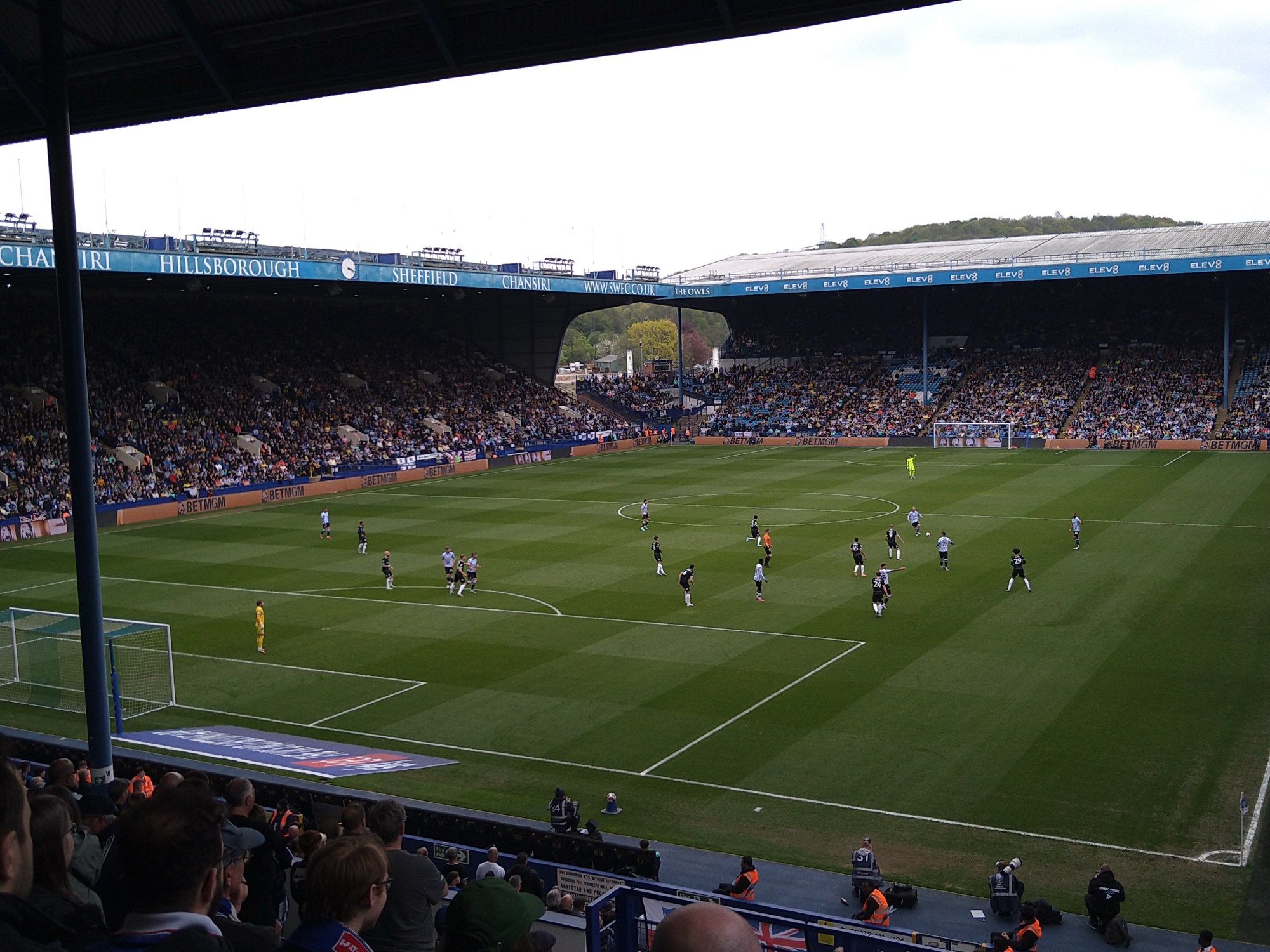
Sheffield Wednesday v Pompey – Saturday 26th April 2025
After securing our Championship status with a 1-0 win over Watford on Easter Monday, Pompey made the long 227-mile journey to Hillsborough in 16th place without the desperate need for points that many of us anticipated just a few weeks ago.
That said, with a decent number of fans travelling up to South Yorkshire, it would be good to see us grab only our fourth league win on the road this season against a Sheffield Wednesday side in 13th place. Plus, we could even finish as high as 12th and in the top half of the table if we win our last two games and results elsewhere go our way.
Pompey last played away to The Owls on the opening day of the 2022-23 season in a memorable 3-3 draw in League One. Whilst our last win at Hillsborough was in November 2002 where two goals by Svetoslav Todorov and one from Gary O’Neil clinched a 3-1 win, en route of course to our promotion/title winning season to the Premiership under Harry Redknapp.
Based in Birmingham, I often take for granted how central I am for Pompey away games where this season, only four clubs in the Championship are further from me than Fratton Park. But with my pre-match sightseeing tour of Sheffield and the M1 on Saturday, I still gave myself ample time for the 90-mile drive.
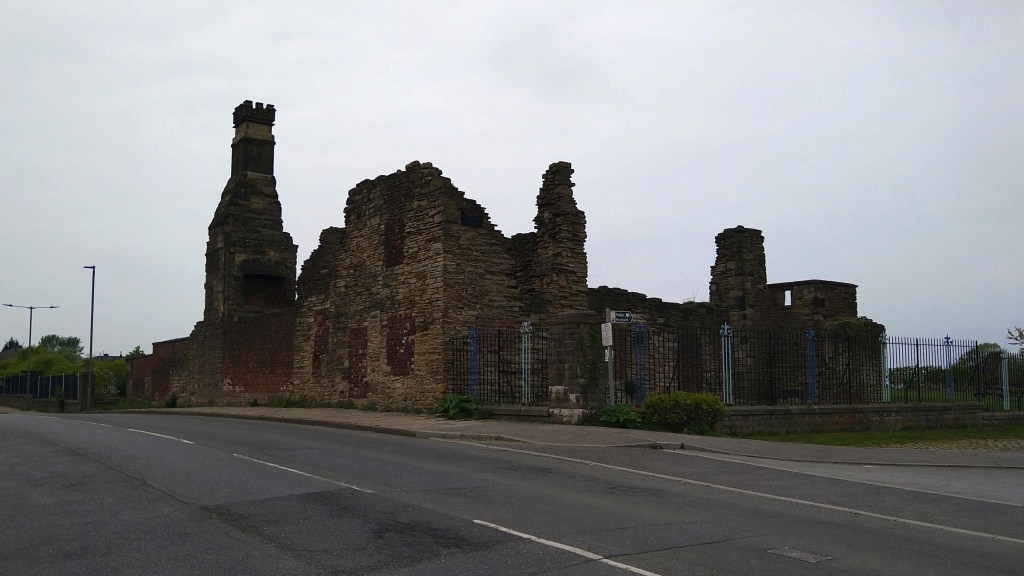
As I entered the ‘Steel City’ with the route I took, I drove past the grade II listed Sheffield Manor Lodge (a couple of miles east of the city centre). Built in circa 1516 during the Tudor times, the estate still has its surviving Turret House (AKA Queen Mary’s Tower – as Mary, Queen of Scots was imprisoned there) as it’s oldest feature. Nowadays the Lodge and its beautiful grounds are a multi-use venue. Pictured below, part of its remains that are visible from Manor Lane.
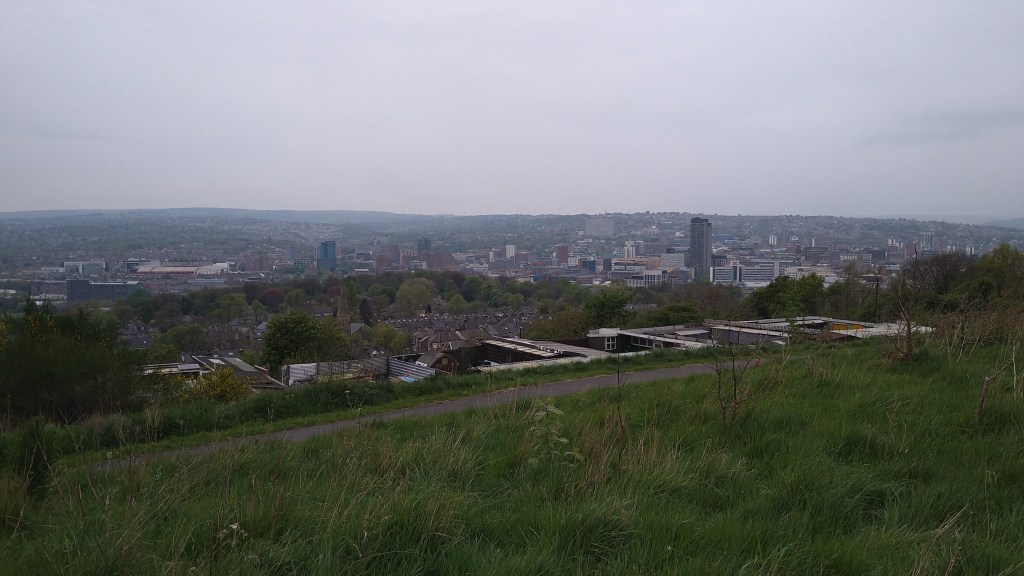
My next stop about a half mile from here is surely the best panoramic view of the city centre skyline and beyond at the aptly named Skye Edge fields. If like myself, you who were a fan of the classic 90s film The Full Monty, it was here that my favourite scene was filmed – the football training session which had Make Me Smile (Come Up and See Me) by Steve Harley & Cockney Rebel playing over it.
Despite the different struggles the unemployed characters faced in the film, there was a lovely camaraderie, determination and solidarity in that scene of the men having fun and being there for each other. Pictured below is the approximate location of this. Note, Bramall Lane (home of Sheffield United FC on the left).
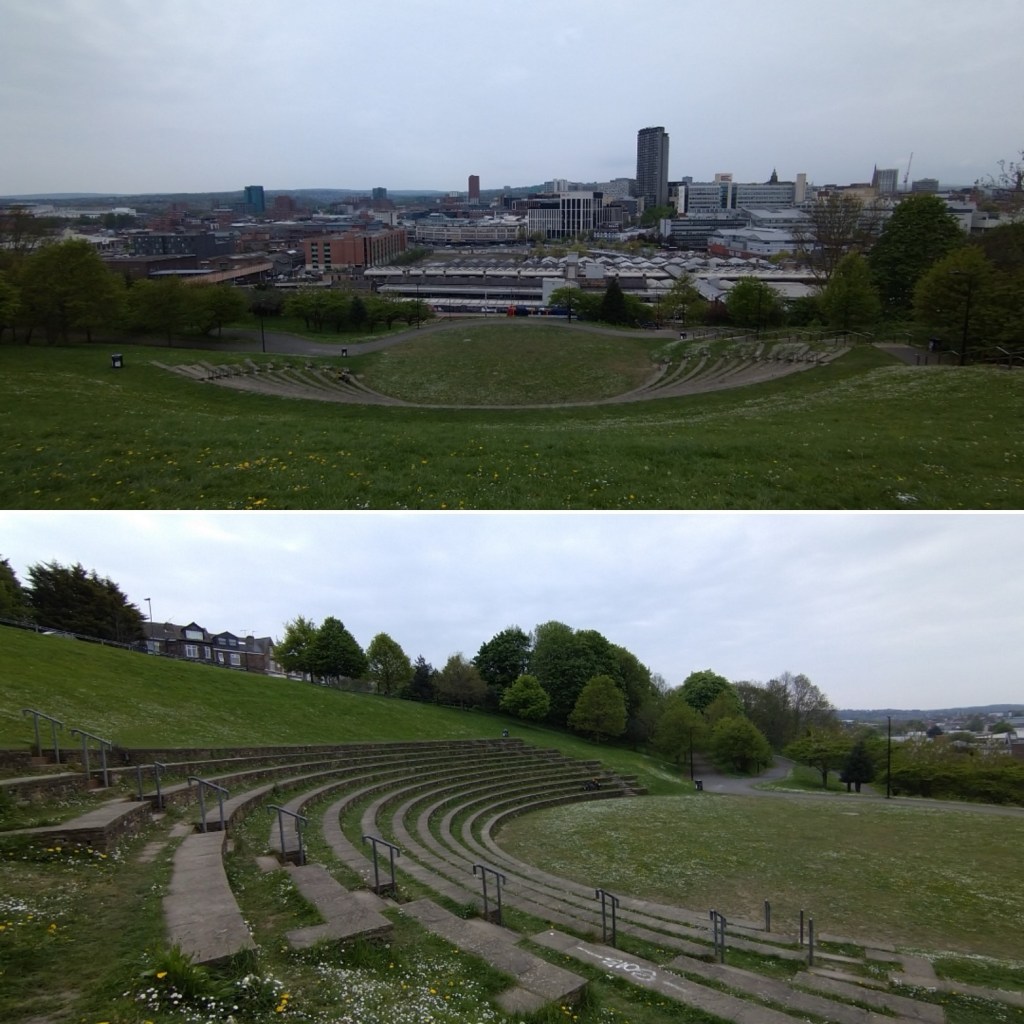
After parking up nearer to the city centre, I came across another wonderful elevated view of the city centre and a feature that at first I thought was an ornate ruin – Sheffield Amphitheatre. But it turns out it was built in 2011 in South Street Park as part of the regeneration of the area between Sheffield railway station and the former Norfolk Park housing estate.
Note St. Paul’s Tower on Arundel Gate. Opened in 2010 this is now the city’s tallest building at 331ft and is predominantly used for apartments with some retail and restaurant facilities. This was part of Sheffield’s Heart Of The City regeneration in that vicinity.
Behind the amphitheatre is a splendid example of 1960s brutalism, Park Hill estate. Built in the late 50s/early 60s, this bold development replaced former back-to-back housing that stood there until their demolition in the 1930s. Due to the slum conditions of these old houses and level of violent crime, they were dubbed locally in the 30s as ‘Little Chicago’.
Despite the decline of Park Hill in the 70s and 80s, the concrete complex was preserved due to its identity for the city and its place in architectural history. In 1998 it gained the incredible accolade as the largest grade ii listed building in Europe. Pictured in the collage below are one of the adjoining concourses from South Street and from Park Square footbridge, you get a good idea of the sheer scale of it.
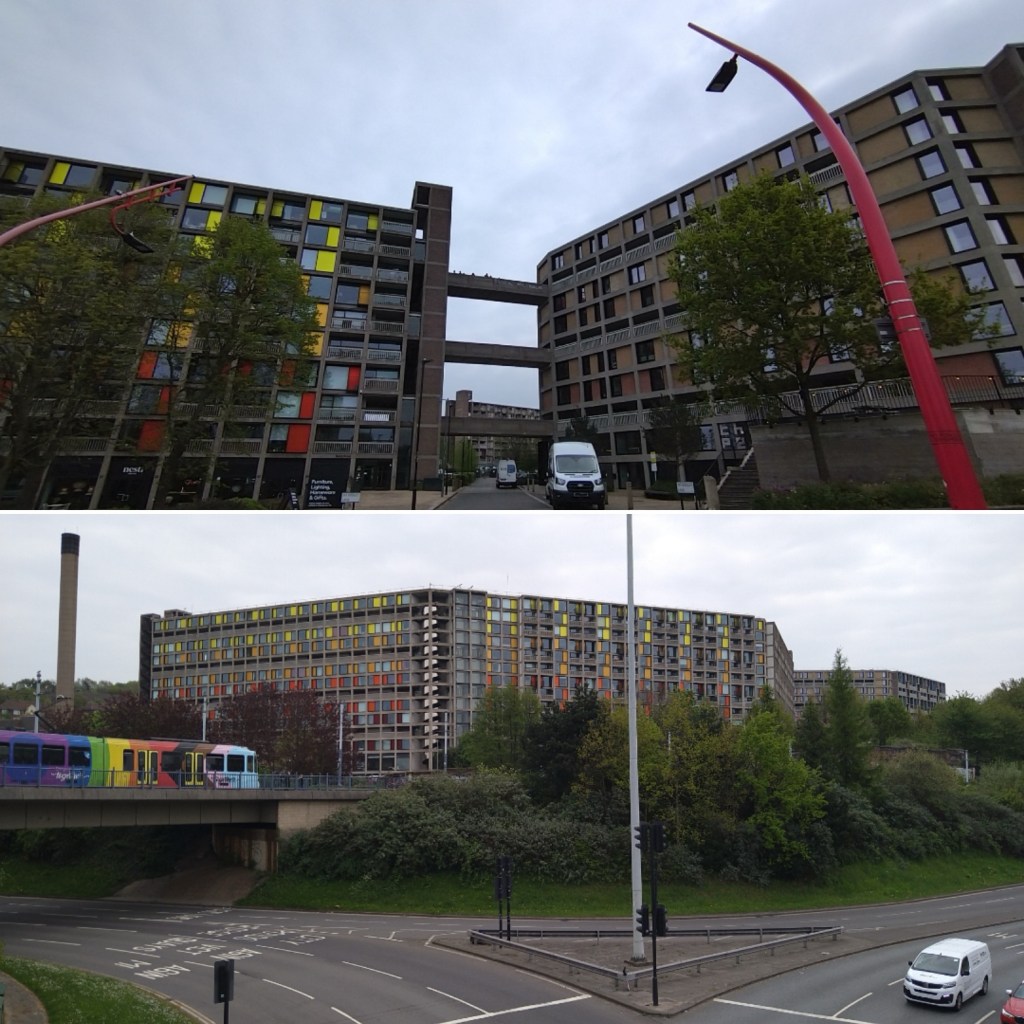
After regeneration company Urban Splash purchased and extensively renovated the former estate in the mid-Noughties, it is now a mixture of privately owned apartments, student accommodation, and rented property.
I made my way along Sheaf Street (A61) and crossed over to take a photo of Sheffield railway station. Opened in 1870, it was originally called Pond Street station and was part of Midland Railway when first in use. It has been re-modelled on other occasions since, but has retained its wonderful Victorian look, complete of course with the Salmon of Steel sculpture outside.
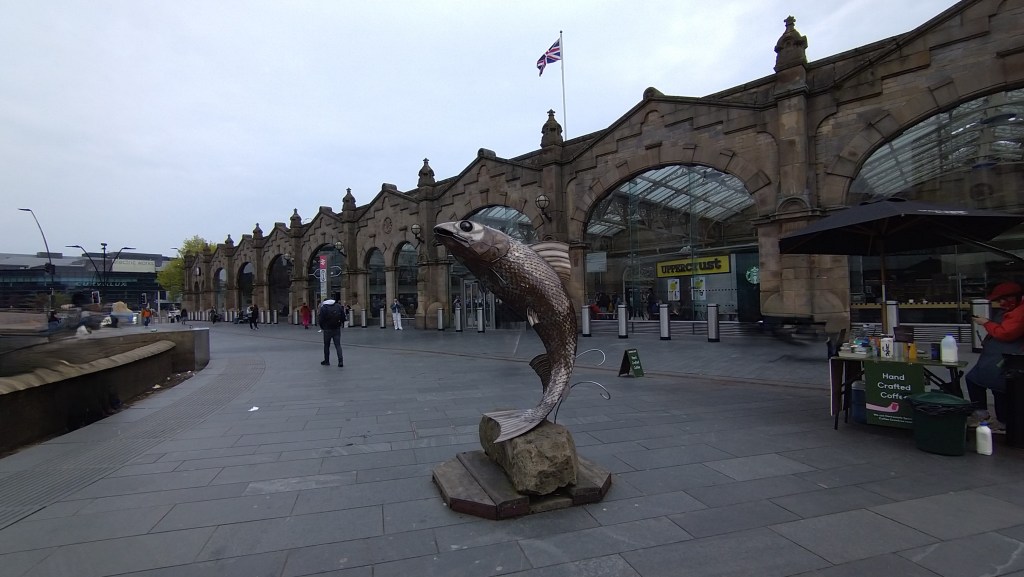
Designed by scrap metal artist Jason Heppenstall in 2020, it consists of a variety of scrap metal from across the city including over 1,500 spoons and some 1960s lamps. The 7ft sculpture heralds a joint operation on the extensive clean-up work to the River Don over the past two decades. After an absence in the city of 200 years, Salmon can now journey in from the North Sea and eventually into Sheffield.
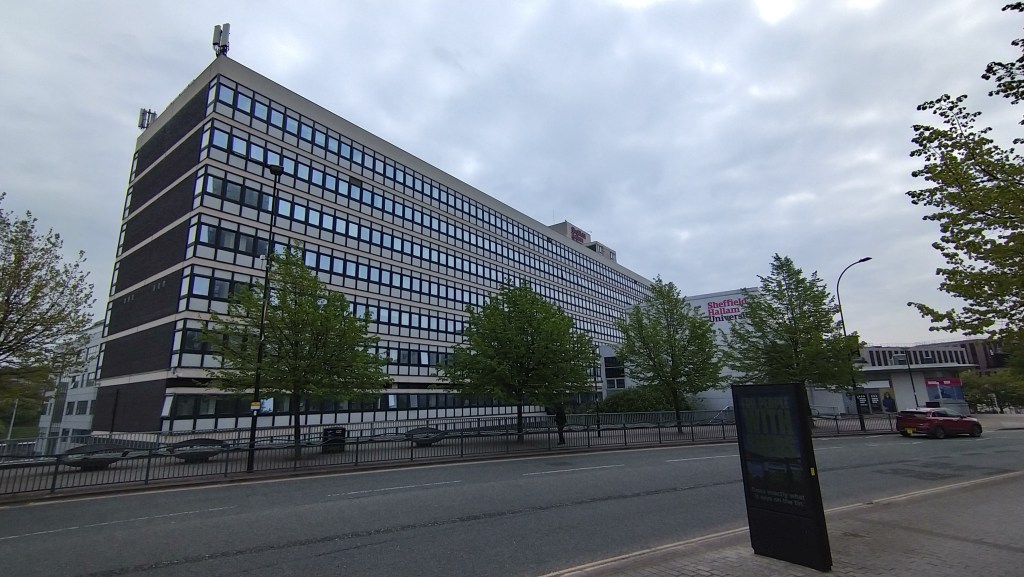
As I made my way into the city centre crossing Arundel Gate, on one side is Sheffield Hallam University’s unmistakably 60s looking Owen Building as pictured below.
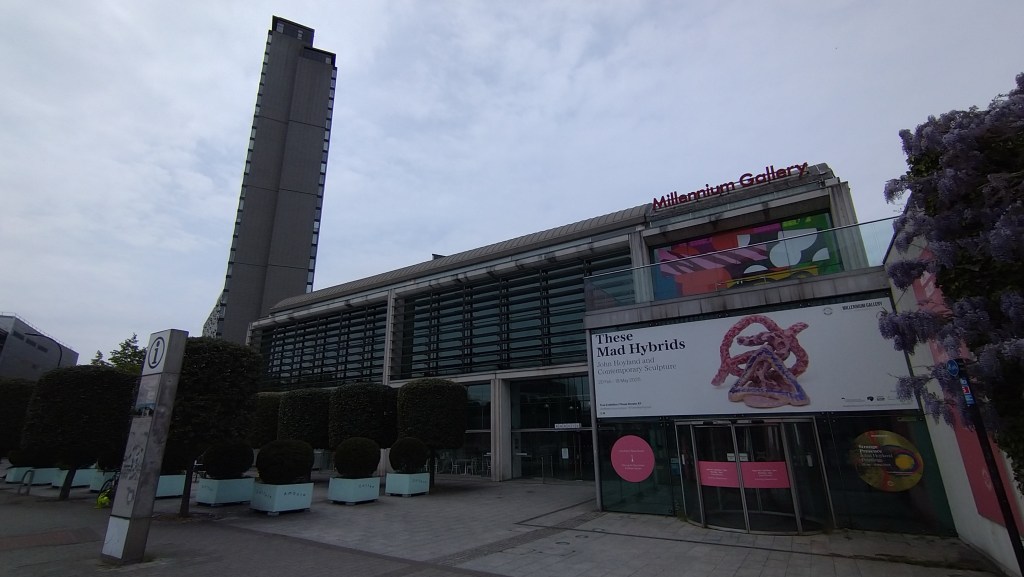
Opposite this is Millenium Gallery as pictured below with the side on profile of St. Paul’s Tower. Opened in 2001, this contemporary art gallery is one of six venues owned and ran by Sheffield Museums Trust. It also has a link to the Winter Garden that opened two years later which I featured in my blog when watching Pompey at Sheffield United in February. All of which are part of Sheffield’s Heart Of The City regeneration in this vicinity that I mentioned earlier.
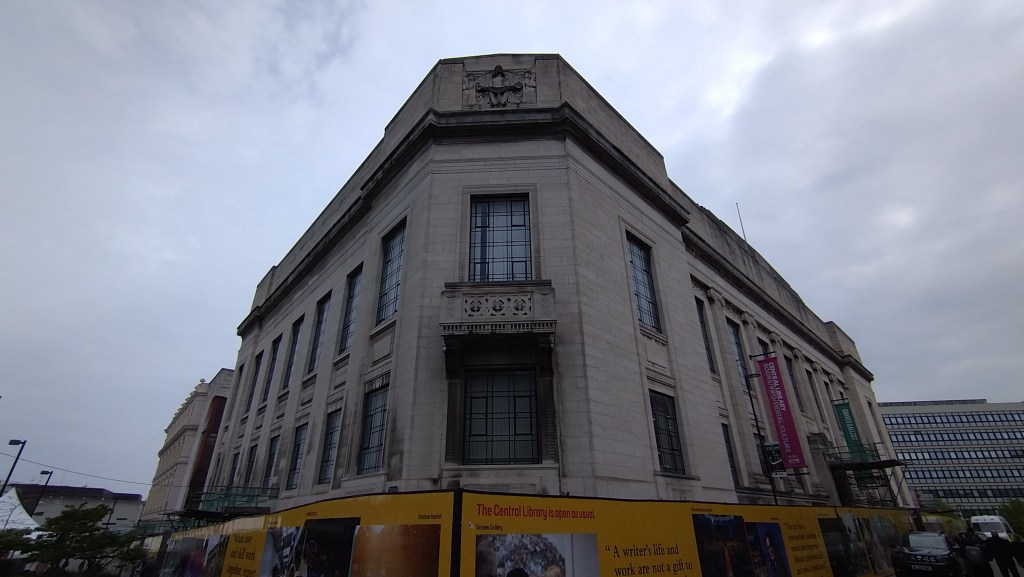
Just around the corner on Surrey Street is one of the other venues the come under Sheffield Museums Trust, Graves Gallery. Situated above Sheffield Central Library, this 1934 building reminded me of the lovely Co-op department store from this era in Fratton Road, Portsmouth before it was replaced by The Bridge Shopping Centre in 1989.
Graves Gallery was named after former Sheffield Lord Mayor John George Graves. As a keen art collector, Graves provided substantial money and art paintings for this gallery.
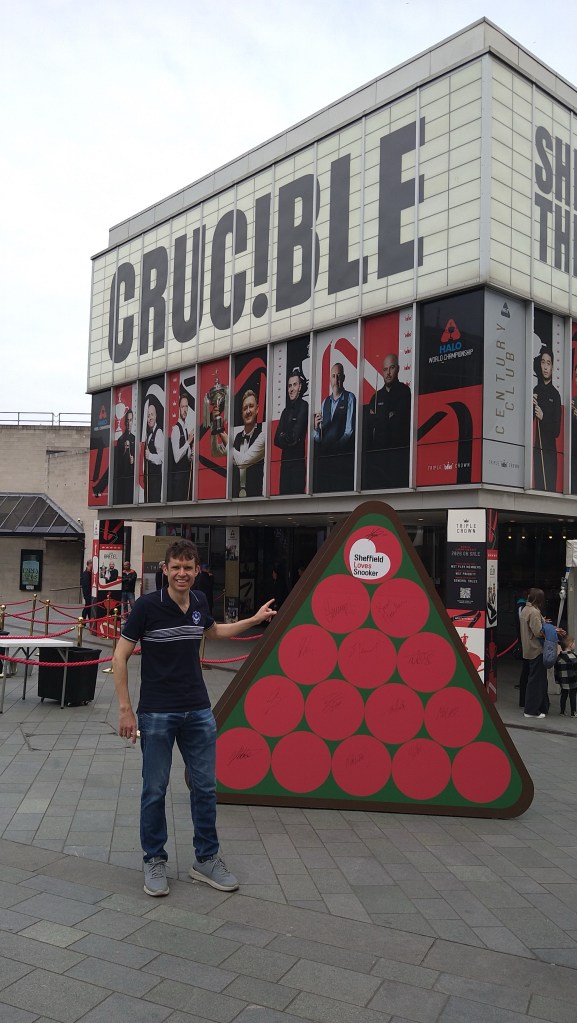
The spotlight is always on Sheffield this time of year as the host city for the World Snooker Championship at The Crucible Theatre. I photographed this in Tudor Square back in February’s blog, but after some Sheffield Wednesday fans clocked my Pompey t-shirt we got chatting about our respective clubs and the afternoon’s game. One of them kindly took a photo of me outside the iconic venue.
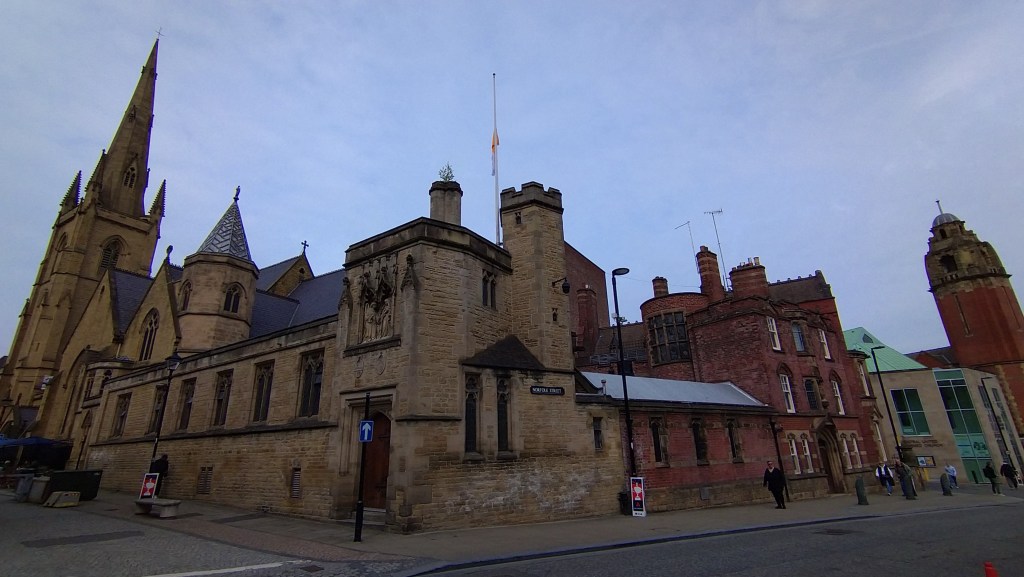
Across Norfolk Street from The Crucible Theatre is Sheffield’s Roman Catholic Cathedral Church of St Marie. Despite opening in 1850 it has only been a cathedral since 1980. On Saturday, it felt all the more poignant walking past it as the funeral mass was taking place for Pope Francis.
After stopping for some lunch, I made my way over to another of the six museums owned by Sheffield Museums Trust – Weston Park Museum about a mile west of the city centre. But not before passing some other classic old buildings.
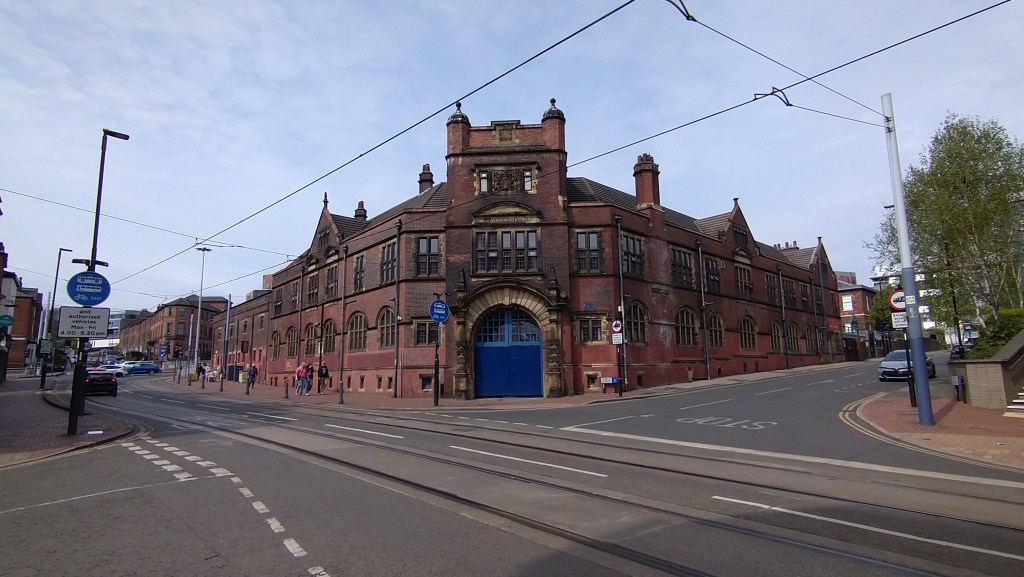
Pictured below on the corner of Glossop Road and Gell Street are the Somme Barracks. Opened in 1907, this fabulous grade ii listed Edwardian building is owned by the Ministry of Defence where the University of Sheffield Officers’ Training Corps (part of the Yorkshire Officers’ Training Regiment) are based.
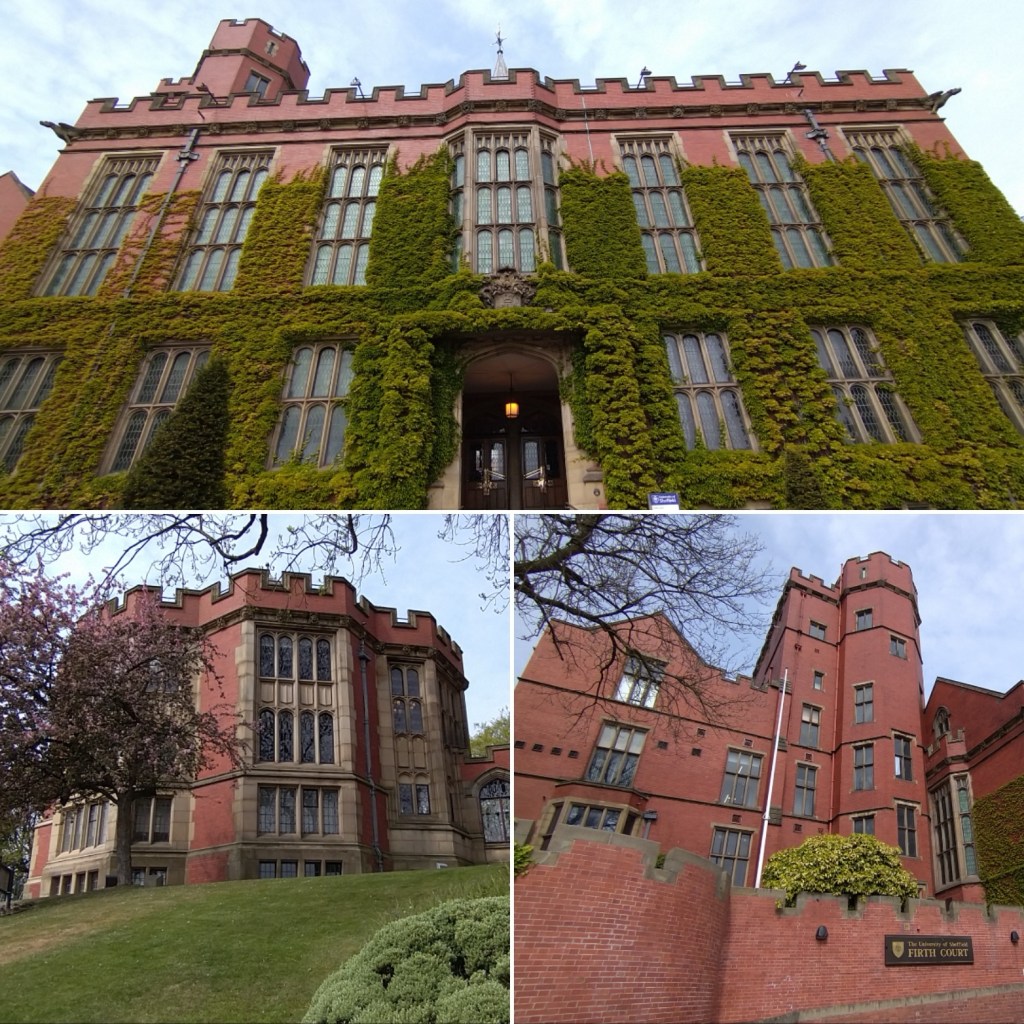
A couple of blocks away on Brook Hill (A57) is another splendid grade ii listed Edwardian building – Firth Court. As the main administrative centre for the redbrick University of Sheffield, the collage below shows the elegant looking entrance and The Rotunda chapter house which was the Edgar Allen Library when first opened.
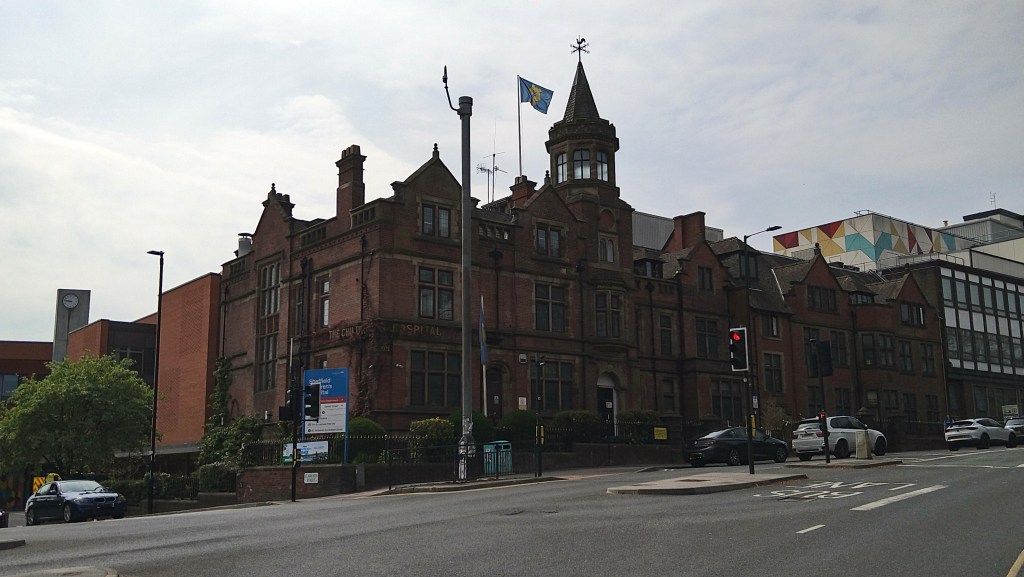
Then across the road as pictured below is Sheffield Children’s Hospital on Clarkson Street which opened in 1876.
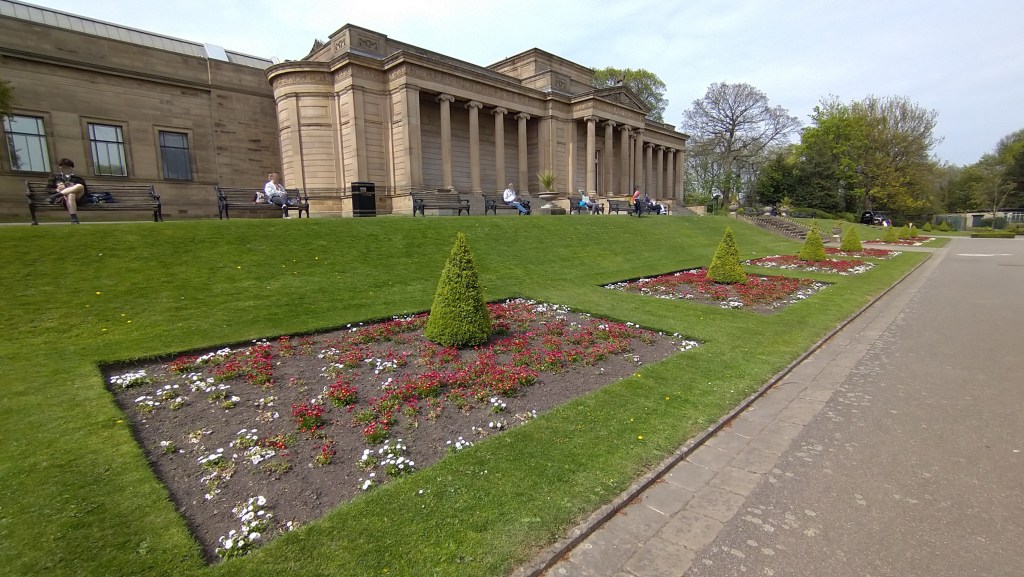
Next to the University of Sheffield is the city’s largest museum Weston Park Museum, which, as the name suggests, is in Weston Park. This grand looking building opened in 1937 replacing the former Weston Hall that dated back to 1795 of which the park itself were its grounds.
The museum opened in 1875 and later became the Sheffield City Museum and Mappin Art Gallery (named after local brewer John Newton Mappin). Like Graves and the city centre gallery, Mappin provided money and his own art collection on the condition that an art gallery for the public was built. The art gallery was in use in both the different buildings with the replacement surviving extensive damage in WW2. With several changes and a major renovation in the 2000s, this is one of the key museums to enjoy in the city.
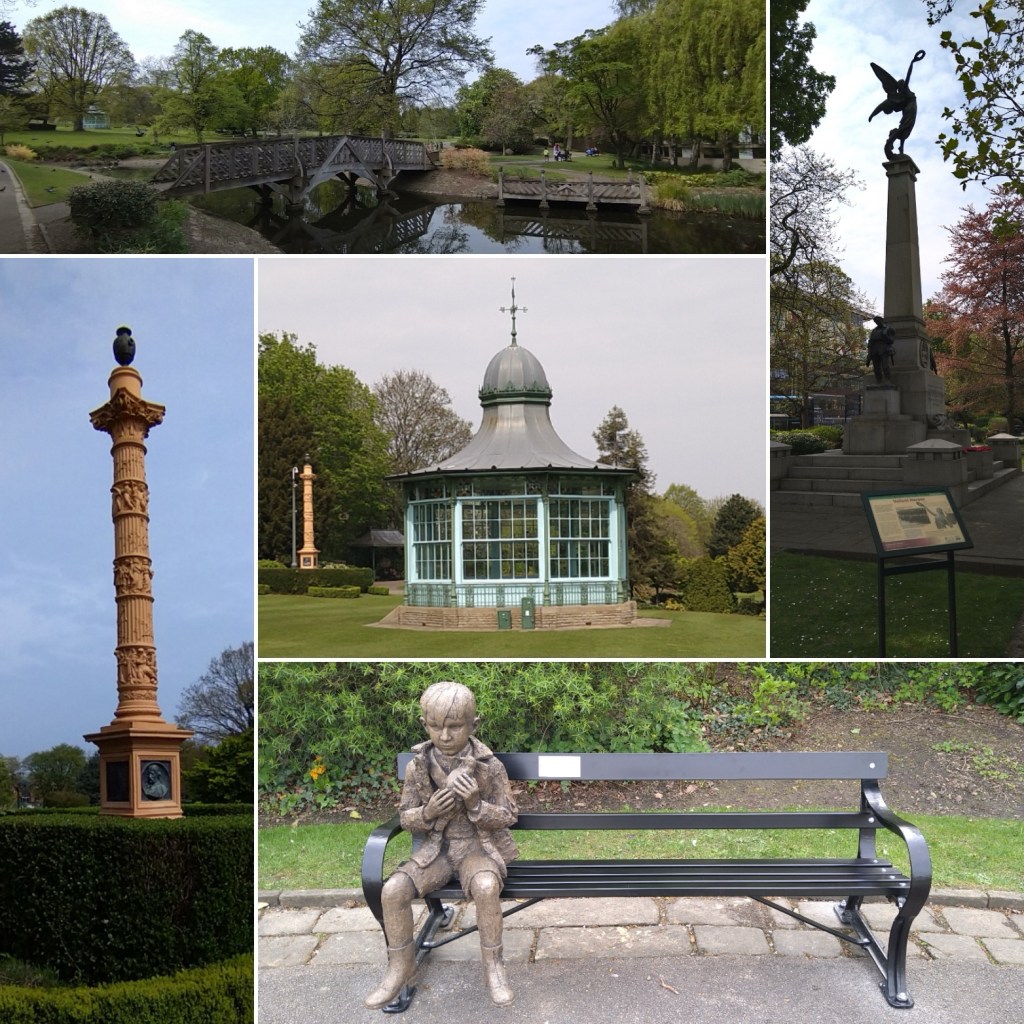
Elsewhere in the park I photographed some of its other features as pictured clockwise in the collage below: Godfrey Sykes Memorial Column, duck pond, ‘Valiant Heroes’ war memorial, bandstand and ‘Boy with Doves’ statue in commemoration of child refugees.
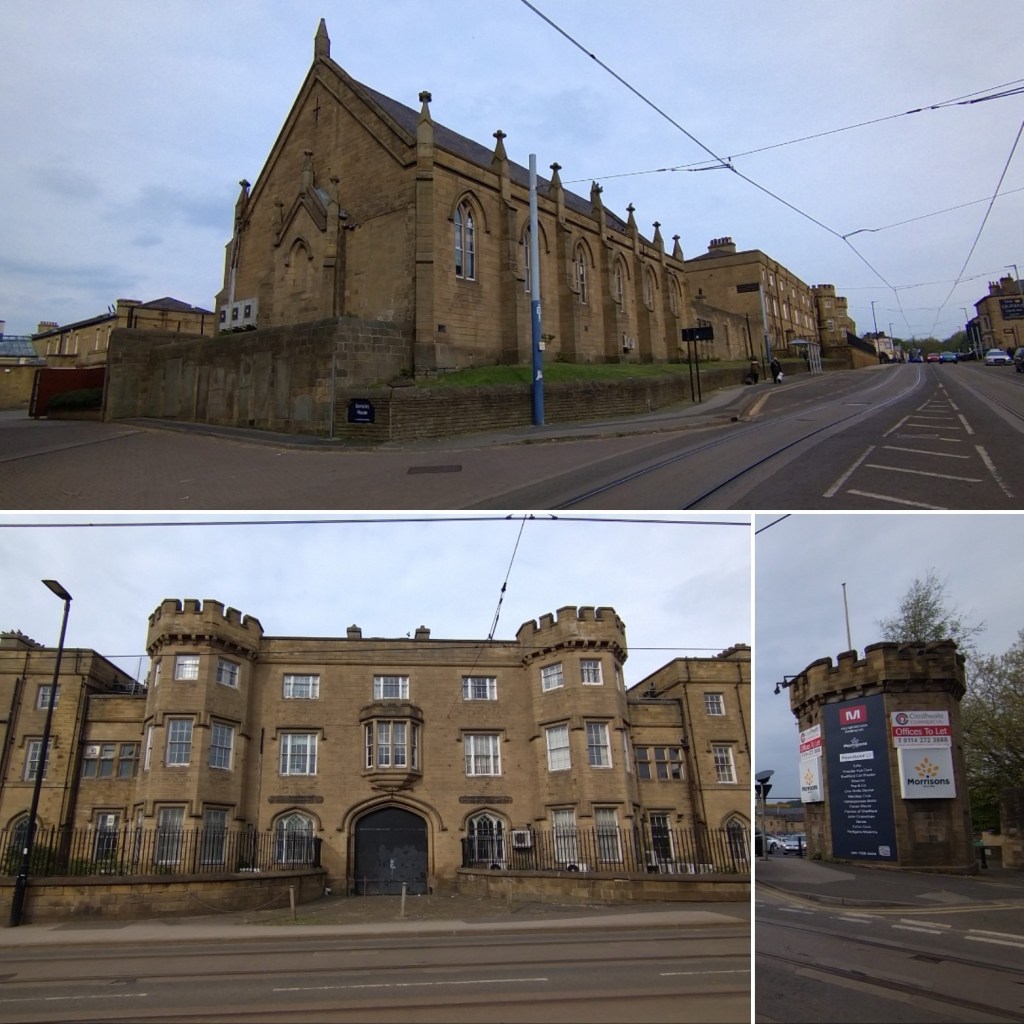
It was approaching half 1 and time for me to get the Supertram from University of Sheffield over towards the stadium. As the tram approached Hillsborough Interchange, I noticed the Victorian Hillsborough Barracks. But as I was pushed for time, I decided to see them after the game.
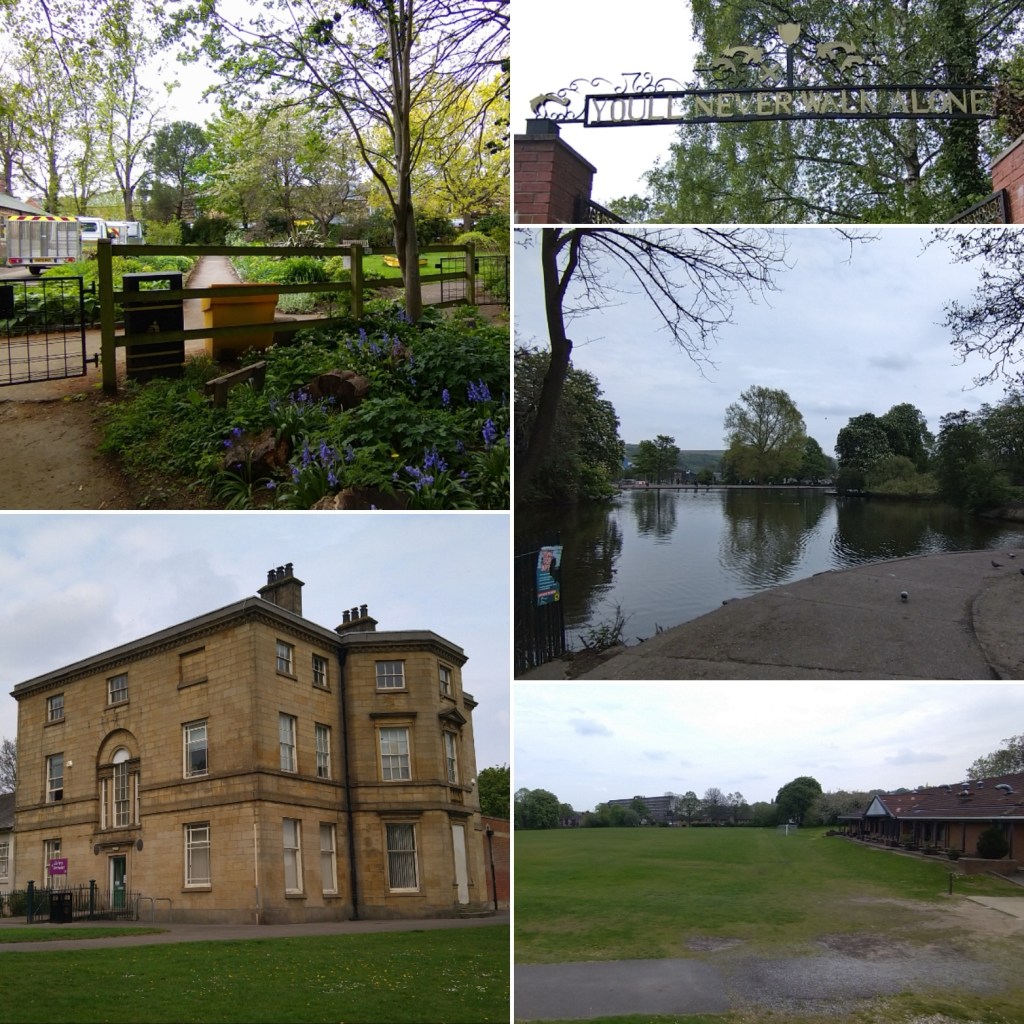
My next stop was Hillsborough Park just south of the stadium. Inside the park is Hillsborough Park Sports Arena, which is one of the former grounds that Sheffield FC (who are widely recognised as the world’s oldest football club) played at in the late 1980s. Hillsborough Park Walled Gardens is a tranquil spot that has its own You’ll Never Walk Alone memorial gates for the 1989 tragedy – more on that a bit later. The park also contains Hillsborough House, which was built in 1779 and has been used as Hillsborough Library since 1906 and a fishing lake, all pictured in the collage below.
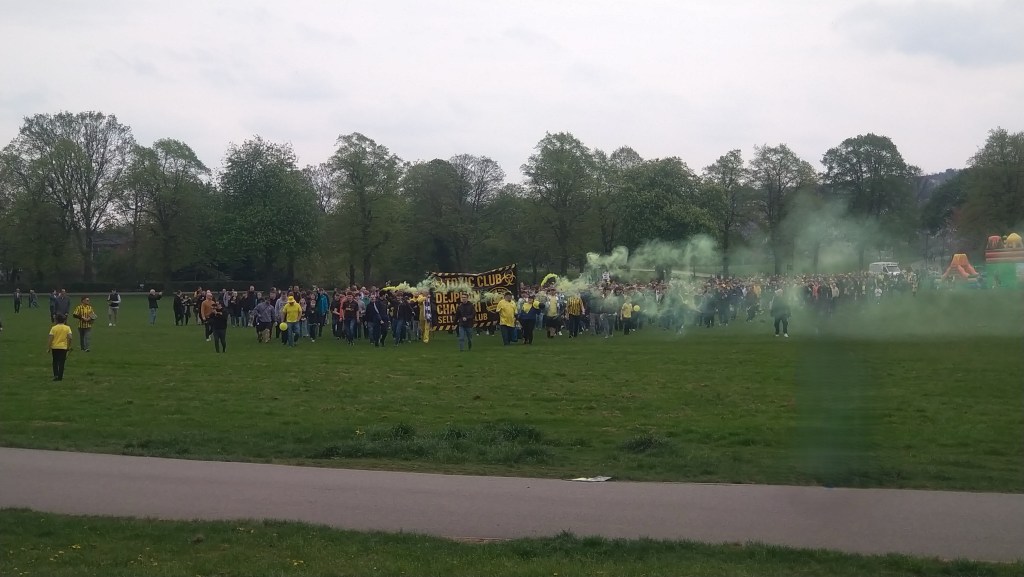
Whilst walking through the park there was a peaceful protest march taking place by the Sheffield Wednesday fans calling for their chairman Dejphon Chansiri to leave. The protest started in fact outside the Crucible Theatre (where the Adelphi hotel once stood where the club was founded). The Owls fans were wearing yellow and black in their protest with balloons handed out with these colours as well as leaflets citing the reasons they want Chansiri to sell their club. Pictured below is the protest march itself.
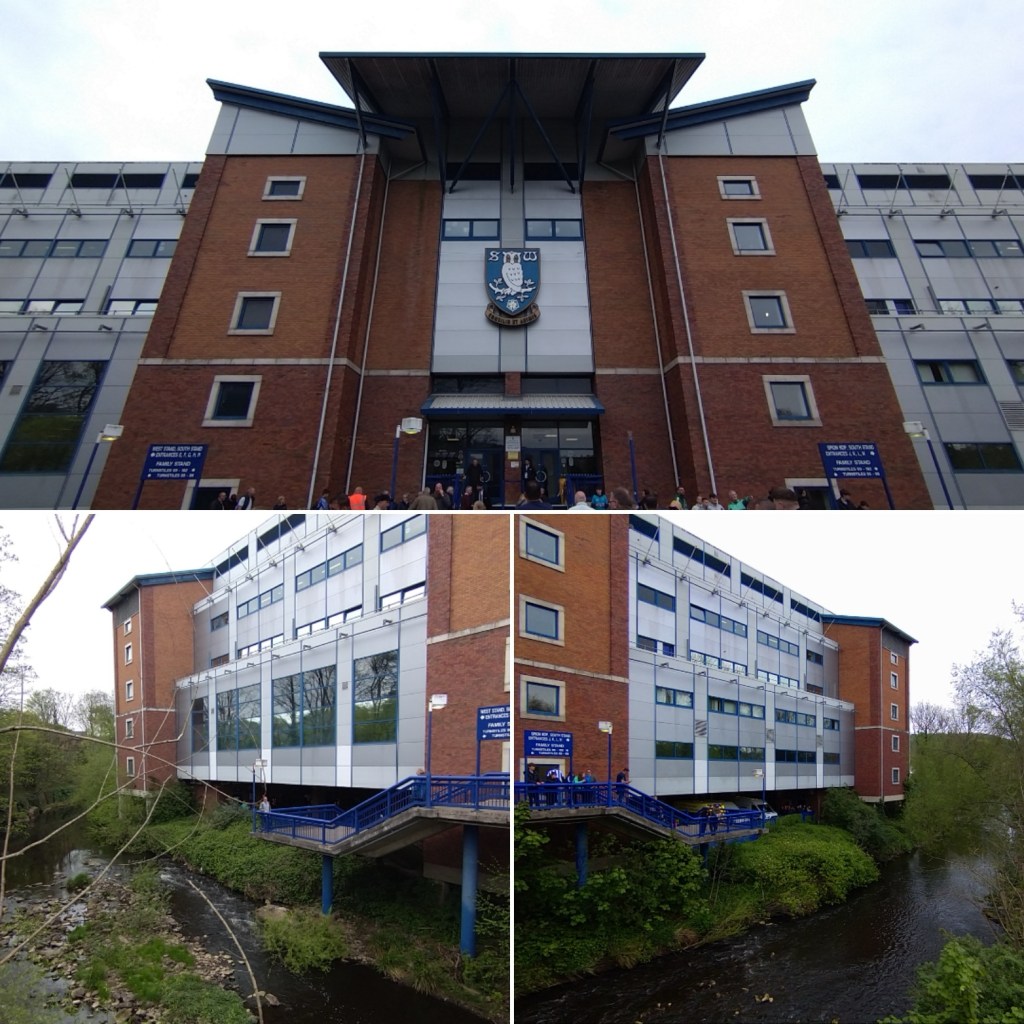
When I finally arrived at the stadium, I took some photos of Hillsborough’s exterior. First up is the main South Stand across the road from the park. As this is flush against the River Don, it is accessed by a small footbridge. In readiness for hosting group matches at Euro 96, this main stand had executive boxes added along with an extra tier and a cantilever roof replacing the pillared one with a capacity of just over 11k.
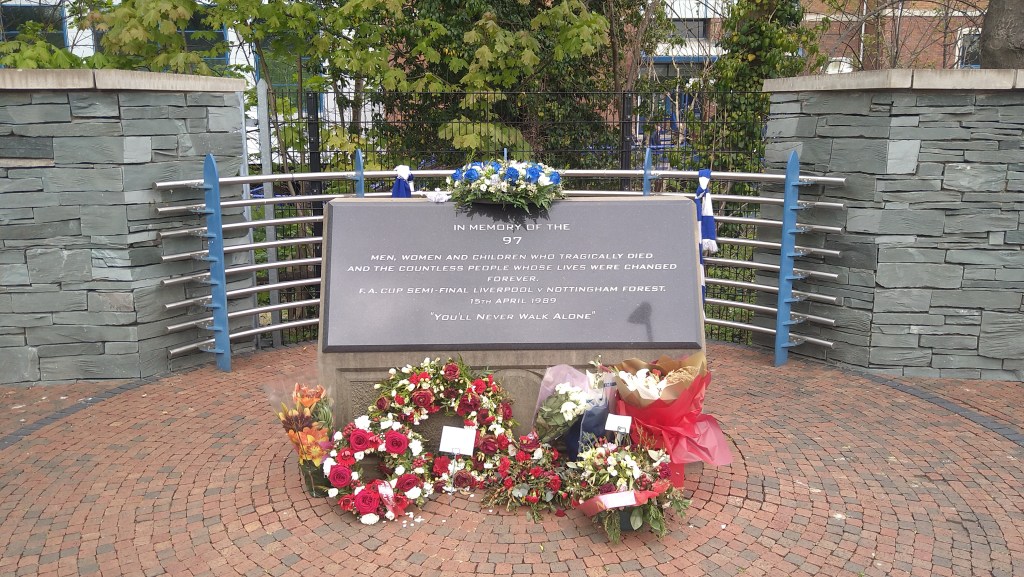
Next to the river outside the stand is something which always puts football into perspective, the memorial for the 97 Liverpool fans who tragically lost their lives here on the Leppings Lane End terrace in their 1989 FA Cup semi-final with Nottingham Forest. Plus of course all those affected as a result of this tragedy.
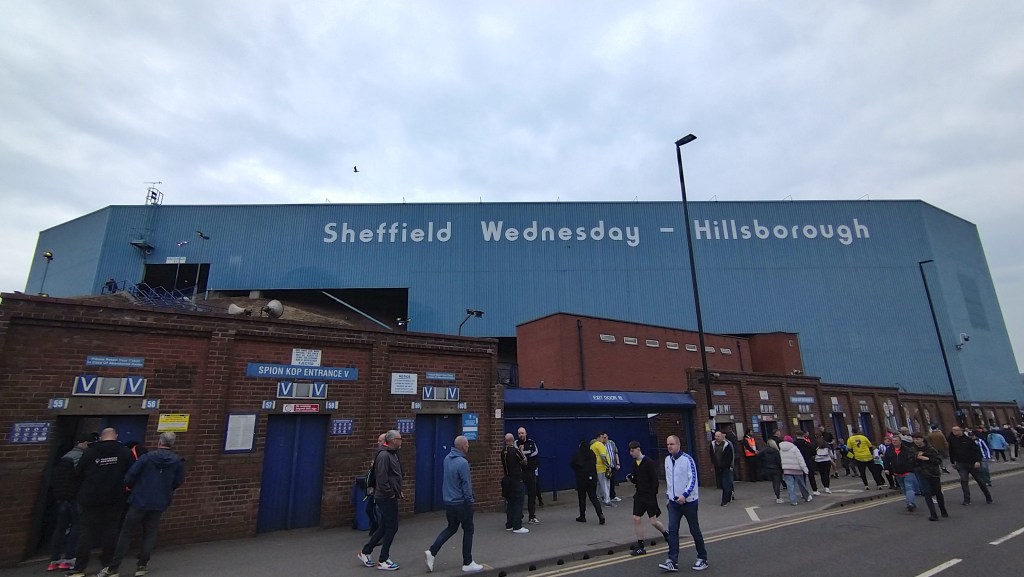
I walked round to Penistone Road North (A61) to their iconic Spion Kop. Originally a huge and indeed bizarre shaped uncovered terrace, in 1986 this was extended and squared off to add this roof making it one of the disputed largest ends in the country. Following the Taylor Report, standing in this end was replaced by seats in 1993, but it still has an impressive capacity in excess of 11k.
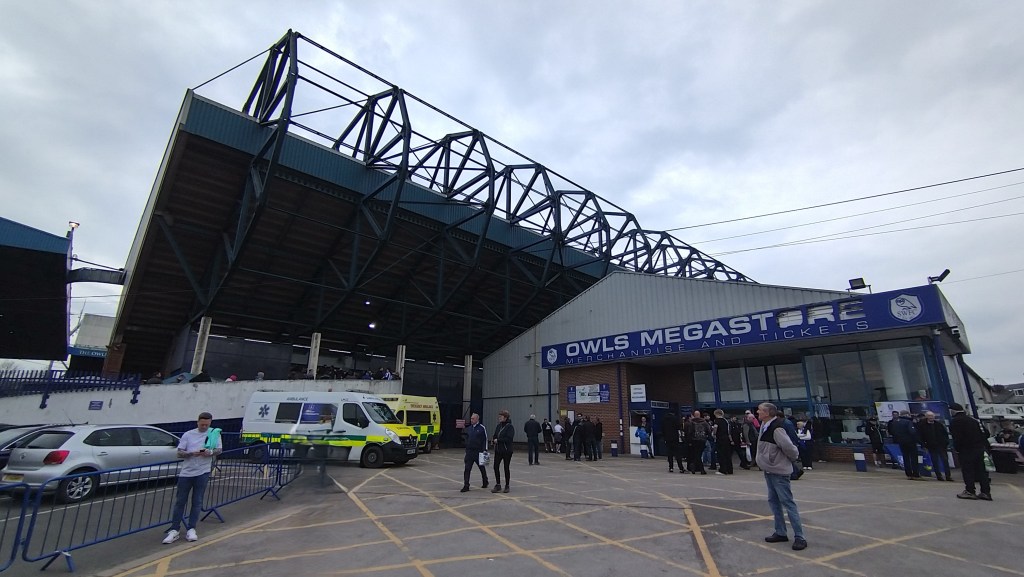
Inside one of the stadium car parks I photographed the North Stand, club shop plus my reminder of course of Wednesday’s opponents this afternoon. Opened in 1961, the North Stand has a capacity of 10k seats. As a large single tiered cantilever stand, this would have been way ahead of its time in English football.
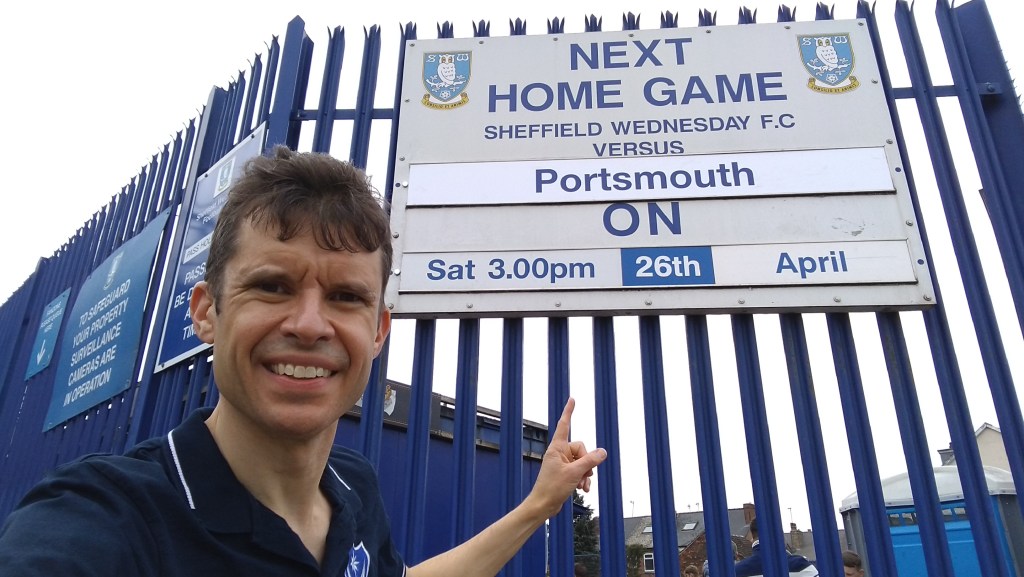
Prior to the new Wembley Stadium being opened, Hillsborough was second only to Villa Park as the most used ground for FA Cup semi-finals. But on a reflective note, it is sadly impossible not to think of this famous old ground without thinking of that fateful day in 1989 and all those who sadly never made it home. This feeling was particularly prevalent as I made my way onto Leppings Lane towards what is now called the West Stand with a modern capacity of 6.6k.
As pictured below, this stand was also built in the early 60s with seats in the upper tier and terracing in the lower tier. The standing area was closed after the 1989 tragedy and only re-opened two years later once both tiers became all-seater with a larger roof added to the stand.

Nowadays, the stadium has 39,732 seats, but due to safety concerns in parts of the stadium it has temporarily been reduced to just over 34k which the club are striving towards having fully in use again.
As you walk inside Hillsborough there is a feeling of what a famous old club Sheffield Wednesday are, so time for a bit of club history. Founded in 1867, they were born out of The Wednesday Cricket Club which was established in 1820 by local tradesmen who played cricket on that day of the week. The football club themselves were formed so the cricket team members could remain active over the winter.
The club was originally called just The Wednesday Football Club and moved to Owlerton Stadium, which is the name of that area of Sheffield, hence where the club nickname and badge emblem The Owls come from. The stadium which opened in 1899 was later renamed Hillsborough stadium and in 1929 the club were renamed as Sheffield Wednesday Football Club. After being selected to the Football League in 1892, The Owls became ones of England’s traditional heavyweight clubs and by 1935 were four times champions of England and three times FA Cup winners.
Until 1970, Sheffield Wednesday had only had 16 seasons outside the top flight, but would have to wait until 1984 to return there, including a spell in (what is now) League One. Barring one season, The Owls remained in the top flight until 2000 where they finishing third under player-manager Trevor Francis in 1992. Eight of those seasons were spent in the newly formed Premier League where under Francis, they also reached the FA and League Cup finals in 1993, missing out to Arsenal in both finals. Ironically in their 1990-91 season outside the top flight (under manager Ron Atkinson), they won their last major trophy to date beating Manchester United in the League Cup final at Wembley.
My only previous visit to Hillsborough was a 0-0 draw in midweek in March 2001 for our (what is now) Championship match with The Owls. On that night, I sat in the upper tier of the West Stand as well.
Demand for away tickets for this fixture was sky high just before Easter as we sold out our initial allocation in the upper West Stand when our relegation threat was still at large. Despite our back-to-back wins over the Easter weekend now making this 13th v 16th game largely a dead rubber, Pompey sold the additional tickets allocated to us last week in the lower tier. Its just a shame these tickets weren’t made available to us prior to the Norwich game as there are number of fans I know who missed out and had since made other arrangements.
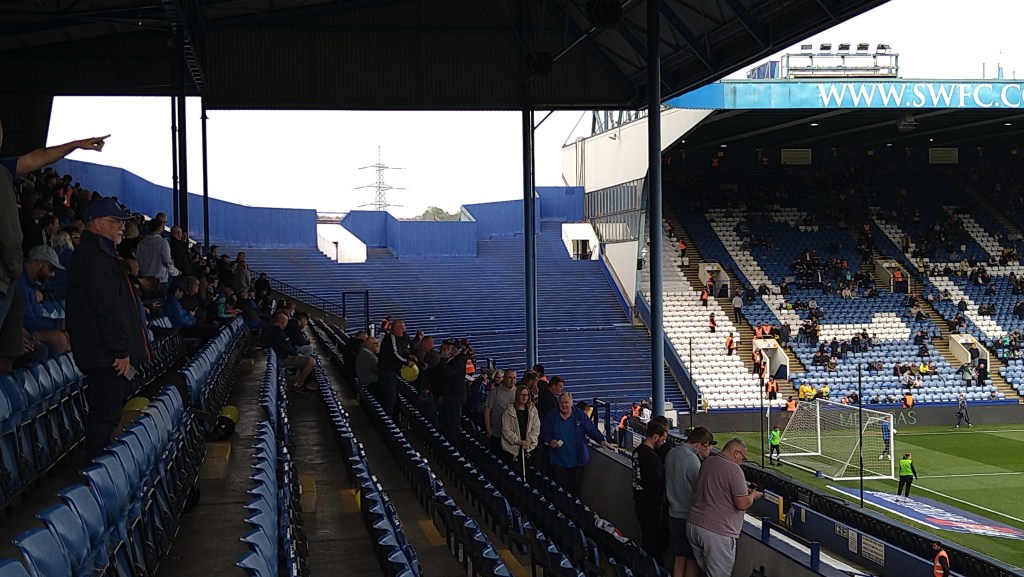
Inside the stadium (as pictured below), on the left is the North Stand, with the uncovered North West corner. This has been used in the past as both a terrace and with seats, but is now completely empty.
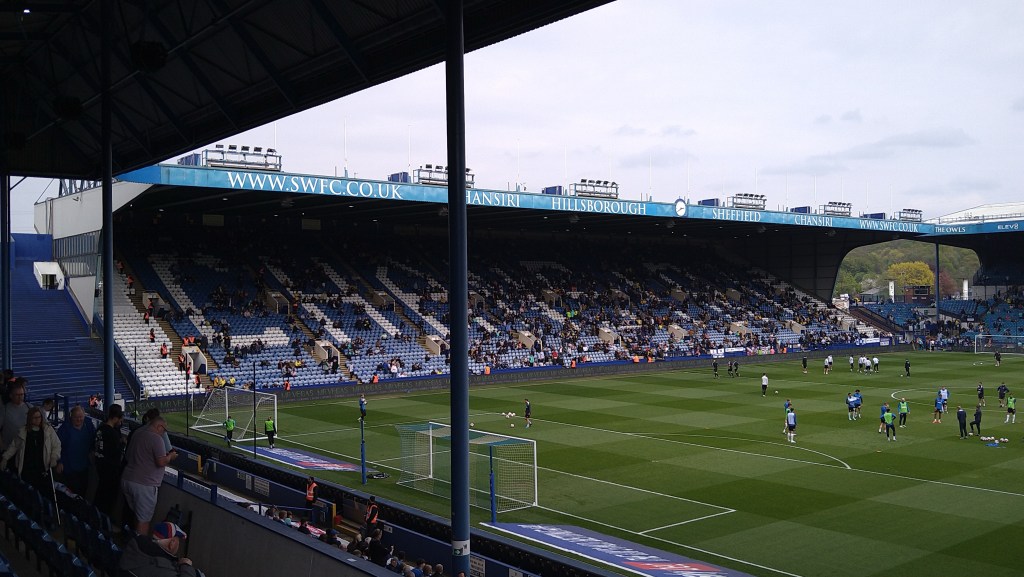
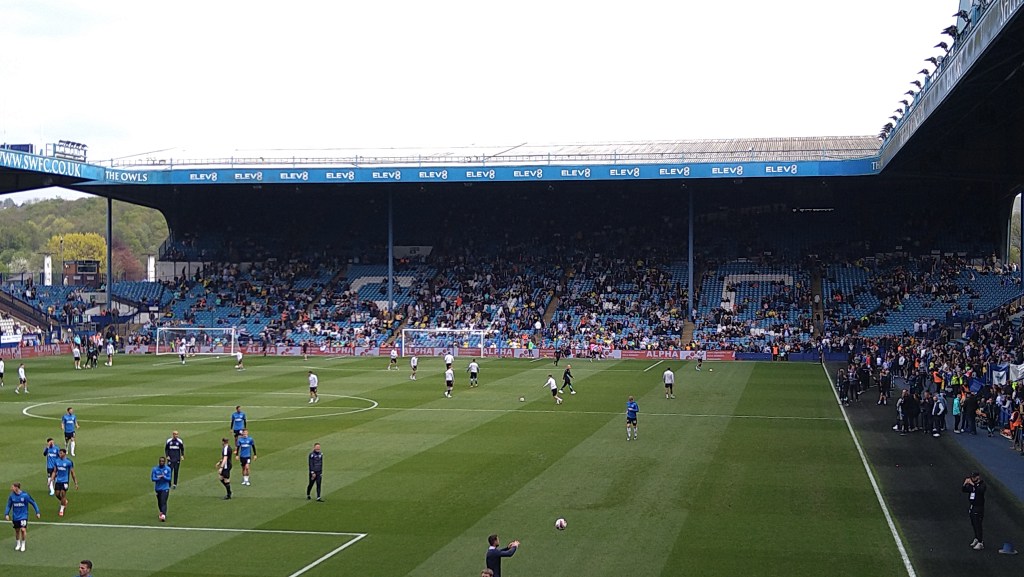
At the opposite end is of course the famous Spion Kop.
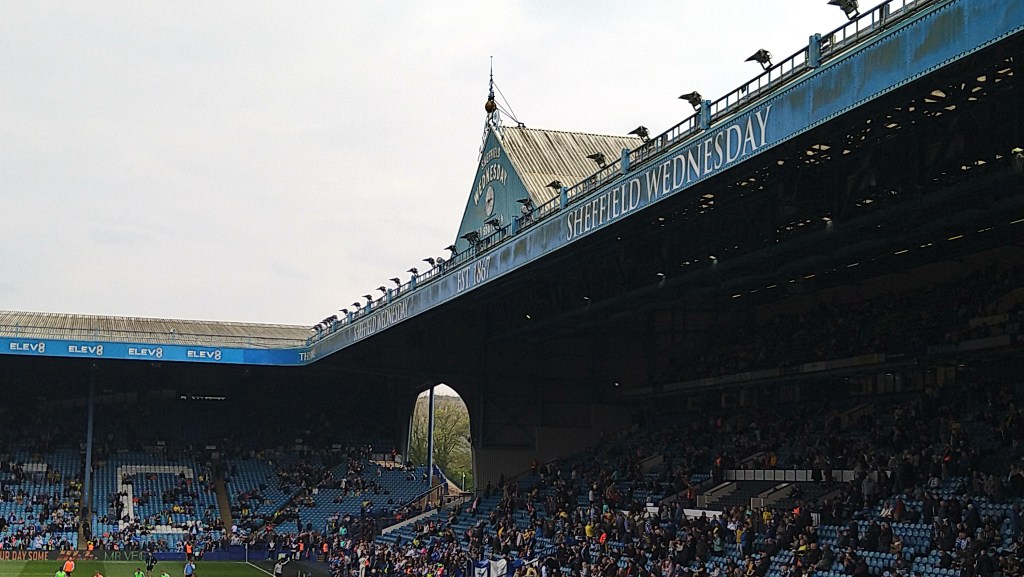
From my seat I couldn’t see up into the extended South Stand on my right, but after I walked to the front of the upper tier, I got a photo of this as well as the fabulous old roof gable designed by Archibald Leitch which was retained during the stand’s 90s revamp.
In the pre-match build up, the PA system played a medley of different club related songs including Waterfront by Simple Minds which I remembered is what Wednesday used to run out to. There was something very evocative and atmospheric about this as I recalled what a household name the club were in the 90s.
It seems improbable to look the size of Hillsborough, which once boasted over 72k in attendance, and was a World Cup venue in 1966, and think that since 2000 the club are yet to return to the top flight. This includes suffering three relegations to League One in the process.
They say no-one has a divine right to success and Hillsborough does look rather dated now. But this century they are one of the biggest (if not the biggest) underachieving clubs in England. As a neutral, I really hope they can one day fulfil their true potential again.
When the players made their way out there was a typical end of season feel to it with nothing truly at stake for either side. There were some Pompey fans in fancy dress and some yellow and black balloons from our fans in support of the home fans’ protest. Then the respective team huddles before the game got underway.
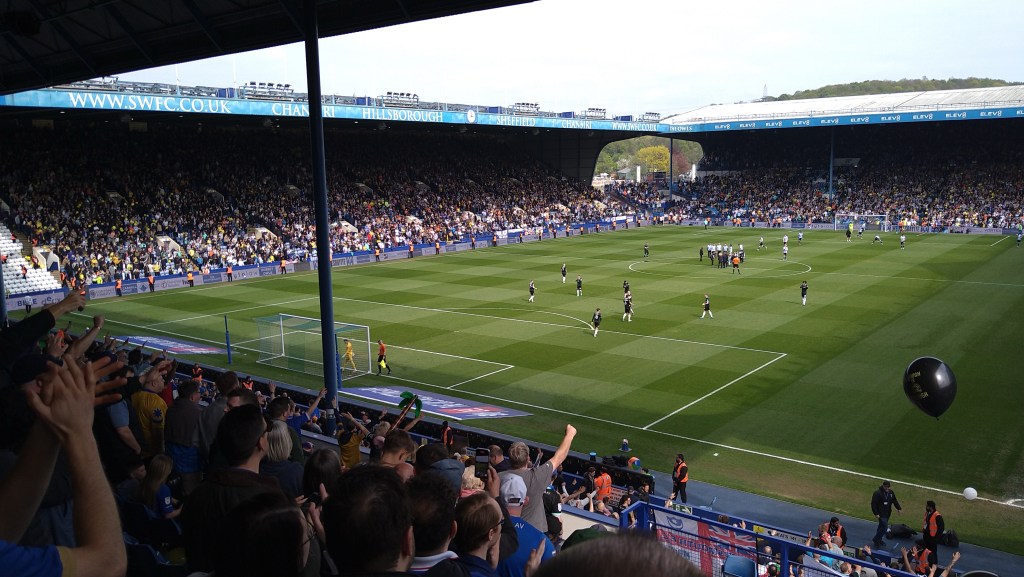
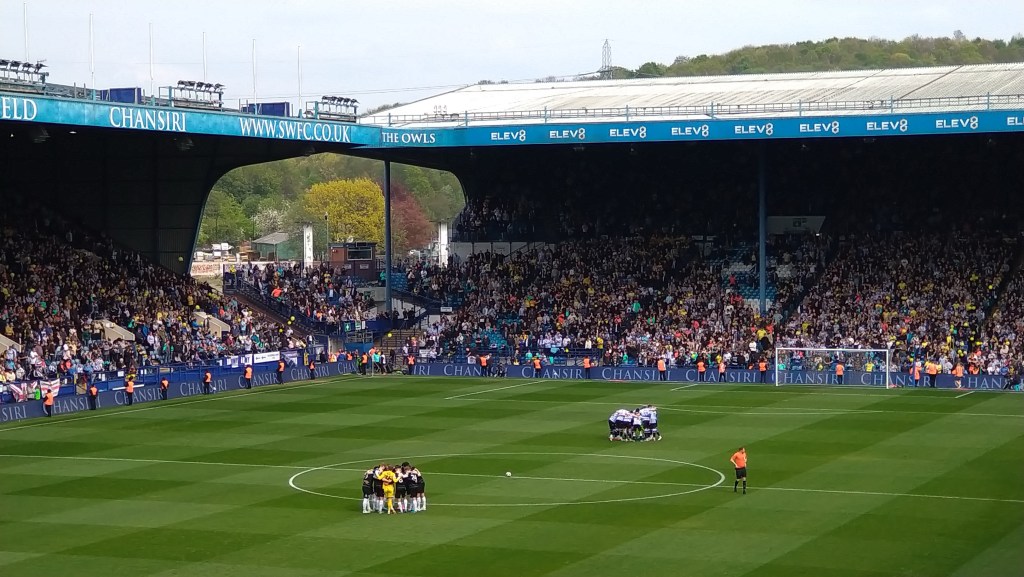
John Mousinho made a total of five changes to his starting XI, most notably handing goalkeeper Ben Killip his debut for the club with Harvey Blair making only his second start for Pompey since his move from Liverpool last summer. As the game started, there were early chances from both sides with the hosts almost going ahead after two minutes when Yan Valery headed over. Then on five minutes, Freddie Potts glanced his header just off target from Andre Dozzell’s corner.
But on nine minutes, Wednesday took the lead from a move that started from the back. Goalkeeper Pierce Charles passed the ball out to Josh Windass who surged forward from midfield and squared to his right. From the cross into the box, former Pompey striker Michael Smith nodded it down as it fell to Stuart Armstrong who appeared to miss-hit his shot as it broke for Callum Paterson to volley down into the ground and in off the crossbar. There was nothing that debutant Killip could have done to keep that out as the Wednesday players and fans celebrated.
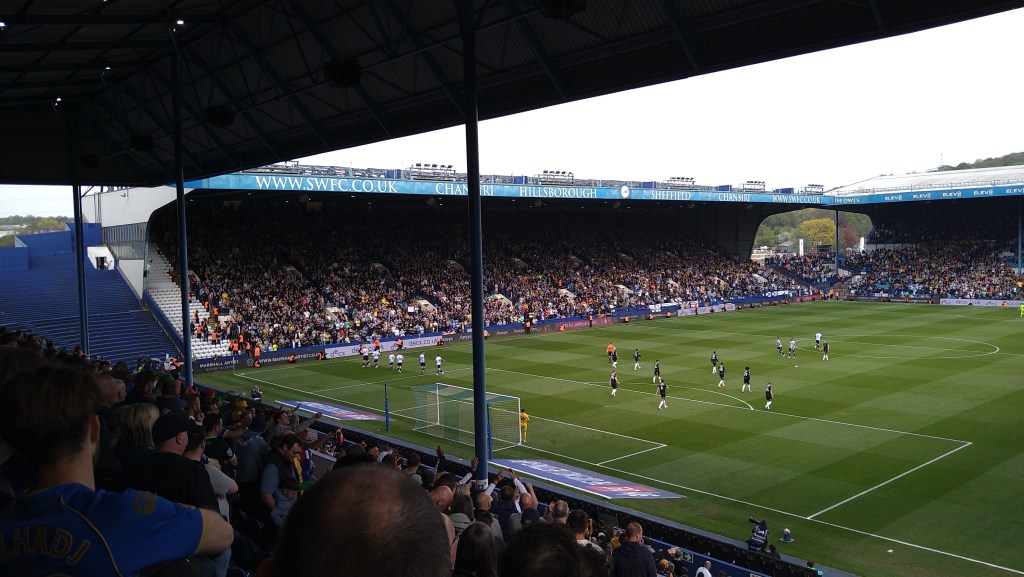
Both sides continued to attack and on 23 minutes Pompey drew level. After Wednesday lost possession, Isaac Hayden collected the loose ball and played a nice pass with the outside of his boot to Josh Murphy to run onto down the wing before squaring to Blair to side foot home from close range.

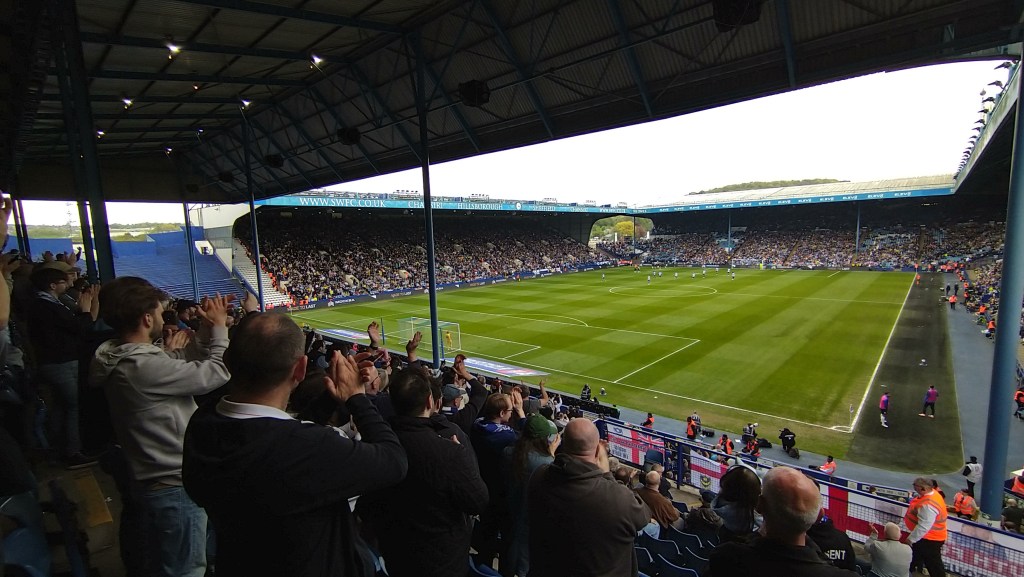
It was a special moment for the 21-year-old as he grabbed his first senior goal in football.
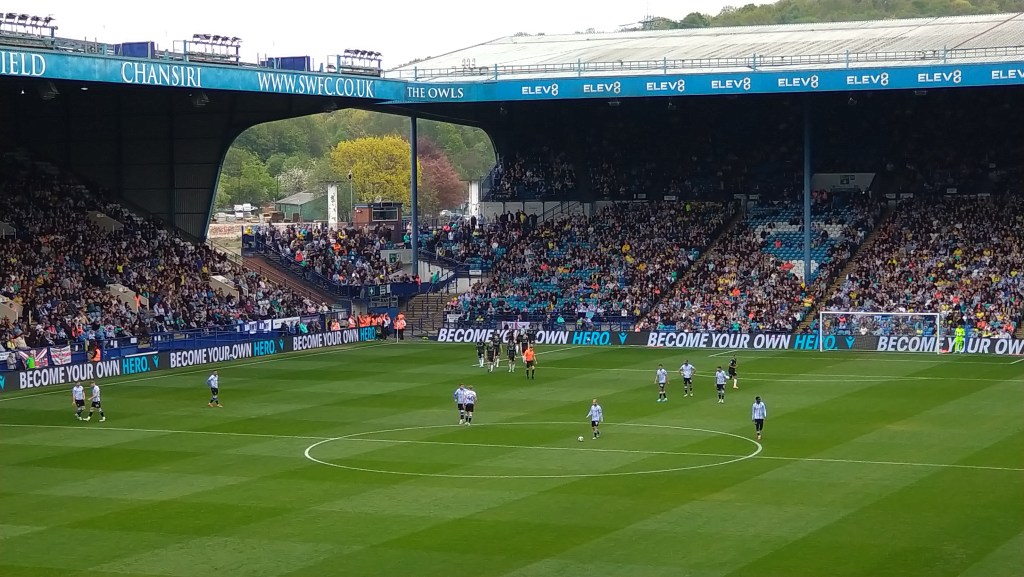
The rest of the half lacked many, if any, goalscoring opportunities, with arguably the best chance created by Wednesday when Shea Charles squared to Valery who cut inside the box from the right, but his low drive lacked any threat as Killip dived down easily to make the save.
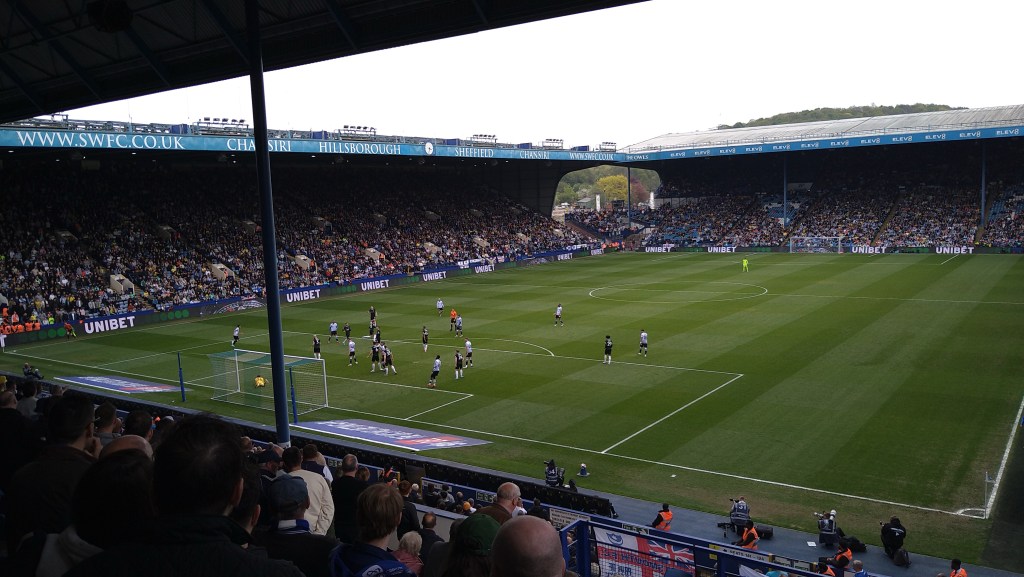
HT: Sheffield Wednesday 1-1 Pompey

At the break, there was a substitution for each side with Regan Poole replacing Conor Shaughnessy for Pompey, whilst for The Owls, Djeidi Gassama made way for Anthony Musaba. Pompey kicked off the second half with both sides kicking towards their fans this half.
Wednesday resumed the livelier after the break and on 50 minutes, a fine bit of skill from substitute Musaba to move into space in midfield, before driving forward and unleashing a good long range shot from outside the box that Killip had to dive down low to his left to keep out. From the resulting corner, the ball fell to Barry Bannan but his effort from just outside the area was held comfortably by Killip.
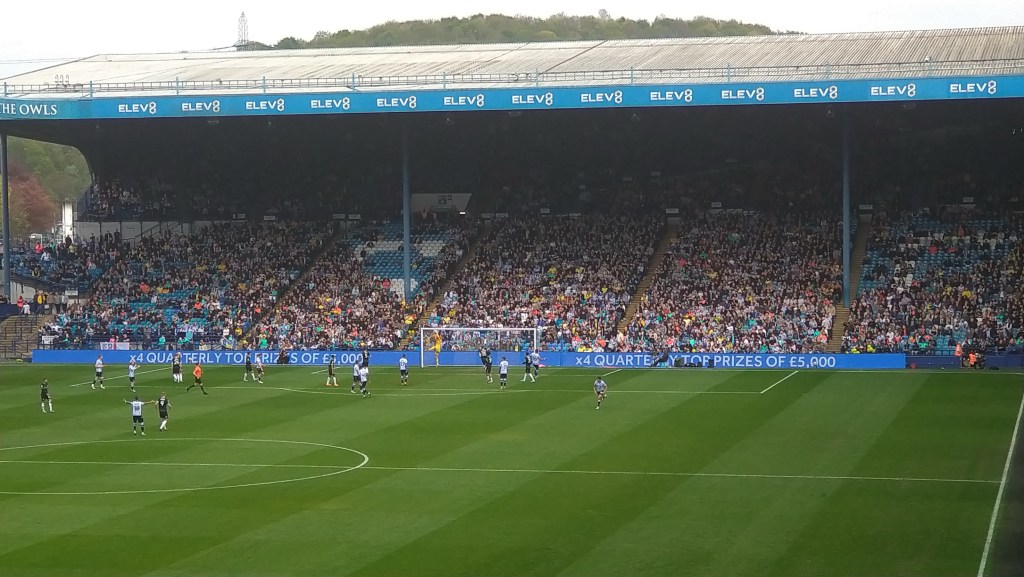
The home side continued to attack with further attempts on goal blocked. Then on 59 minutes, Mousinho made his second substitution as goalscoring hero Blair was brought off for Kaide Gordon.

The game continued to lack any clear-cut chances, although Windass got in a decent effort for the home side which just went over. Further substitutions were made by both Pompey and Wednesday as we headed into the last 20 minutes. The hosts brought Svante Ingelsson on for Armstrong on 69 minutes. Two minutes later, Pompey then made a double substitution with Dozzell making way for Callum Lang and Marlon Pack coming on for Hayden. Then on 74 minutes, Wednesday made a double substitution as Liam Palmer came on for Valery and Nathaniel Chalobah replaced Smith.
As the game entered the final 10 minutes, Wednesday were on the attack again when Michael Ihiekwe played in Chalobah whose low drive from just out the box was held by Killip.
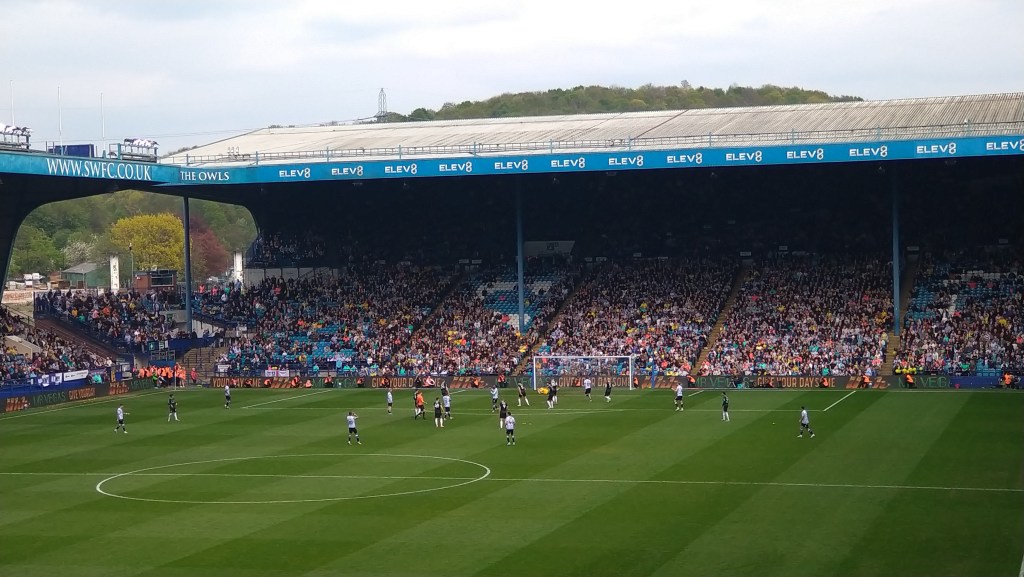
As the game was fizzling out for a draw, Charlie McNeill replaced Paterson for The Owls on 84 minutes. Pompey continued to strive to get that winner and with five minutes to go Rob Atkinson got on the end of Murphy’s free-kick, but his header was off target as Wednesday survived. Murphy was replaced by Cohen Bramall a minute later.
Then on 88 minutes, Wednesday themselves could have won it when Bannan slipped the ball through to Musaba into the box, but he blazed over Killip’s crossbar. That was the last opportunity in the game for either side as the referee signalled the end after nine minutes of stoppage time.
FT: Sheffield Wednesday 1-1 Pompey
Att: 28,346 (2,801 Pompey fans)
The Pompey players applauded our travelling fans at the end who were in pretty good voice considering there was so little to play for in this game. In particular Blair revelled in his own fist pump “Yeah Yeah Yeah” celebration that we so often see in football these days, and Mousinho saluted our fans just before many made the long journey home.
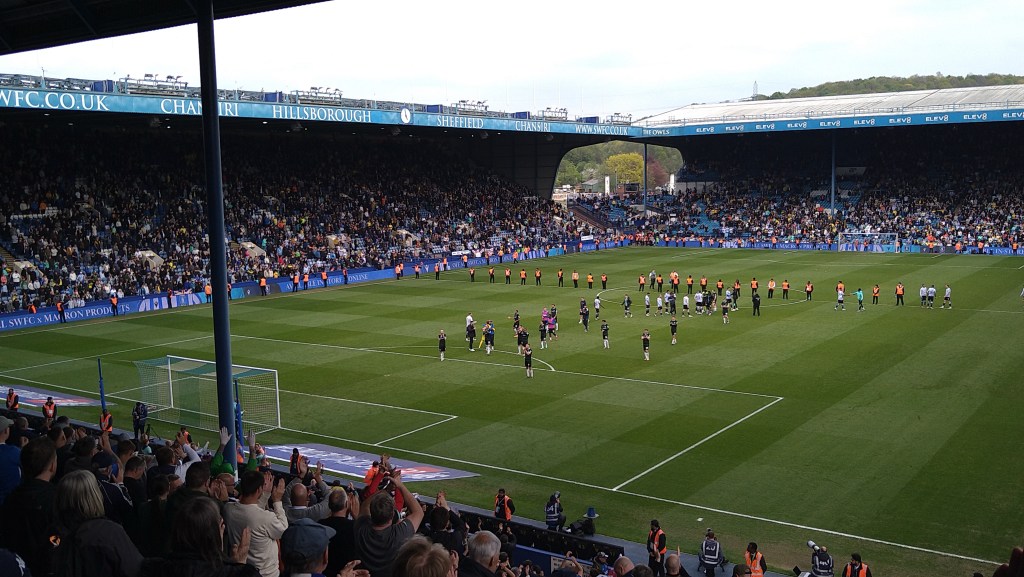
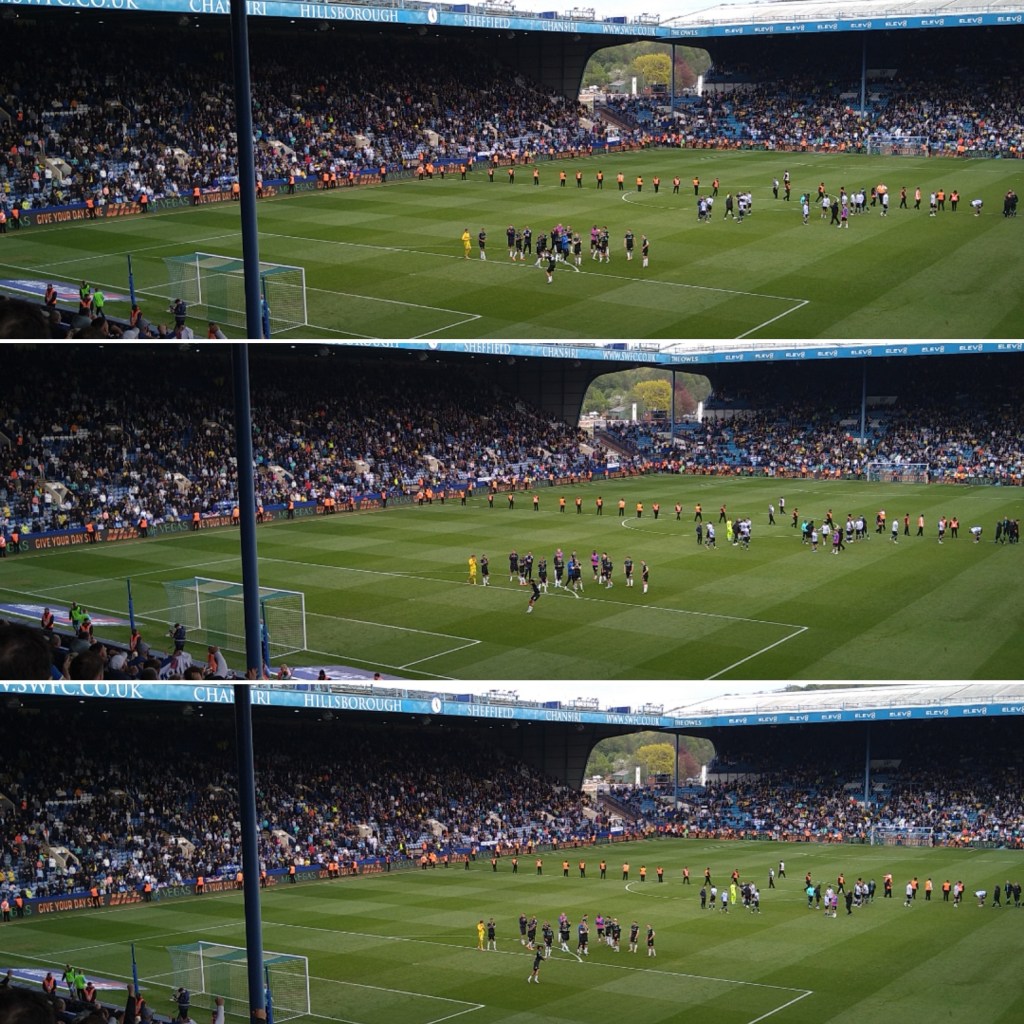
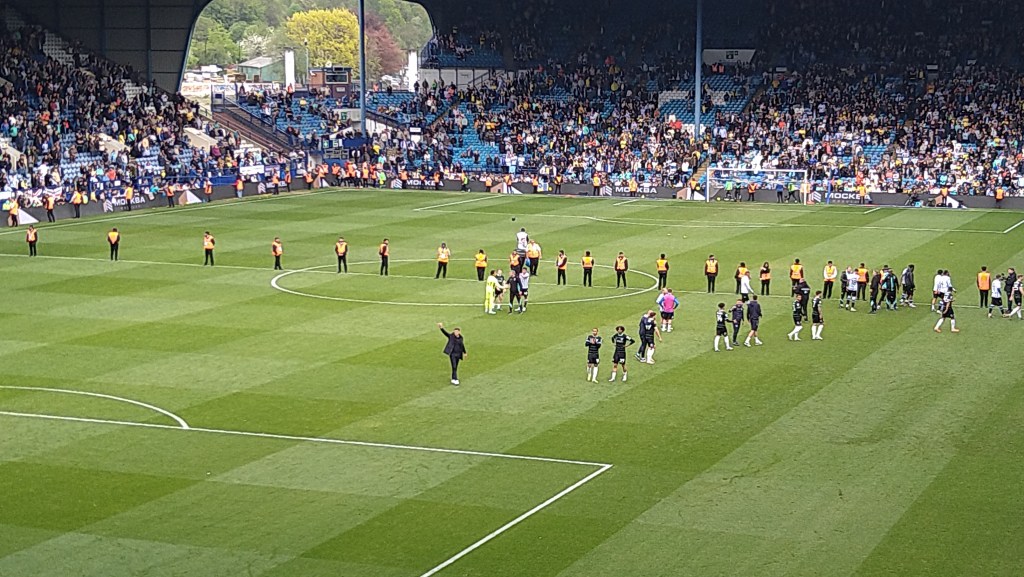
So the draw at Hillsborough means Pompey stay in 16th place in the Championship with a top half finish now beyond us. Although that really would have been a ‘nice to have’ in what has been a fantastic achievement to avoid an instant return to League One.
Elsewhere in the Championship, Cardiff’s draw at home to West Brom wasn’t enough to save them from relegation as The Bluebirds drop into the third tier for the first time since 2003. Plymouth’s two year stay in the Championship effectively came to an end despite winning at relegation threatened Preston as The Pilgrims’ goal difference deficit is significantly greater than any of their relegation rivals. That then leaves one of Stoke, Derby, Preston, Luton or Hull for the final place in the bottom three.
The title is still just about alive with Leeds and Burnley level on points, although Leeds have a much superior goal difference. Sheffield United and Sunderland are long since guaranteed 3rd and 4th place respectively, whilst the final two play-off places go to the wire between Bristol City, Coventry, Millwall, Blackburn and Middlesbrough.
As there was a large queue at Leppings Lane tram stop, I decided to walk back to Hillsborough Interchange to photograph the former army barracks I mentioned earlier. This also allowed for the queues for the trams to reduce. Nowadays this splendid Victorian complex on Langsett Road is used for retail and business purposes including The Garrison Hotel.
Onto the final day tomorrow as Pompey finish off 2024-25 with Hull City’s visit to Fratton Park. A draw would be enough for The Tigers to stay up if Luton lose at West Brom (who can now only finish 9th) or Preston lose at 5th place Play Off hopefuls Bristol City. But a defeat for 22nd place Hull would consign them to relegation.
A truly fascinating finale at both ends of the table and one we can all feel relieved that Pompey’s only formality now is where between 13th and 18th we finish. Here’s to next season for Mousinho’s side. PUP PPU.
 PompeyNewsNow
One of the best blogs I`ve ever read, travelogue, and match report in one. It rekindled my love of my hometown, well done
LikeLike
Fantastic blog, great read
All the best for the rest of the season
WAWAW
LikeLike