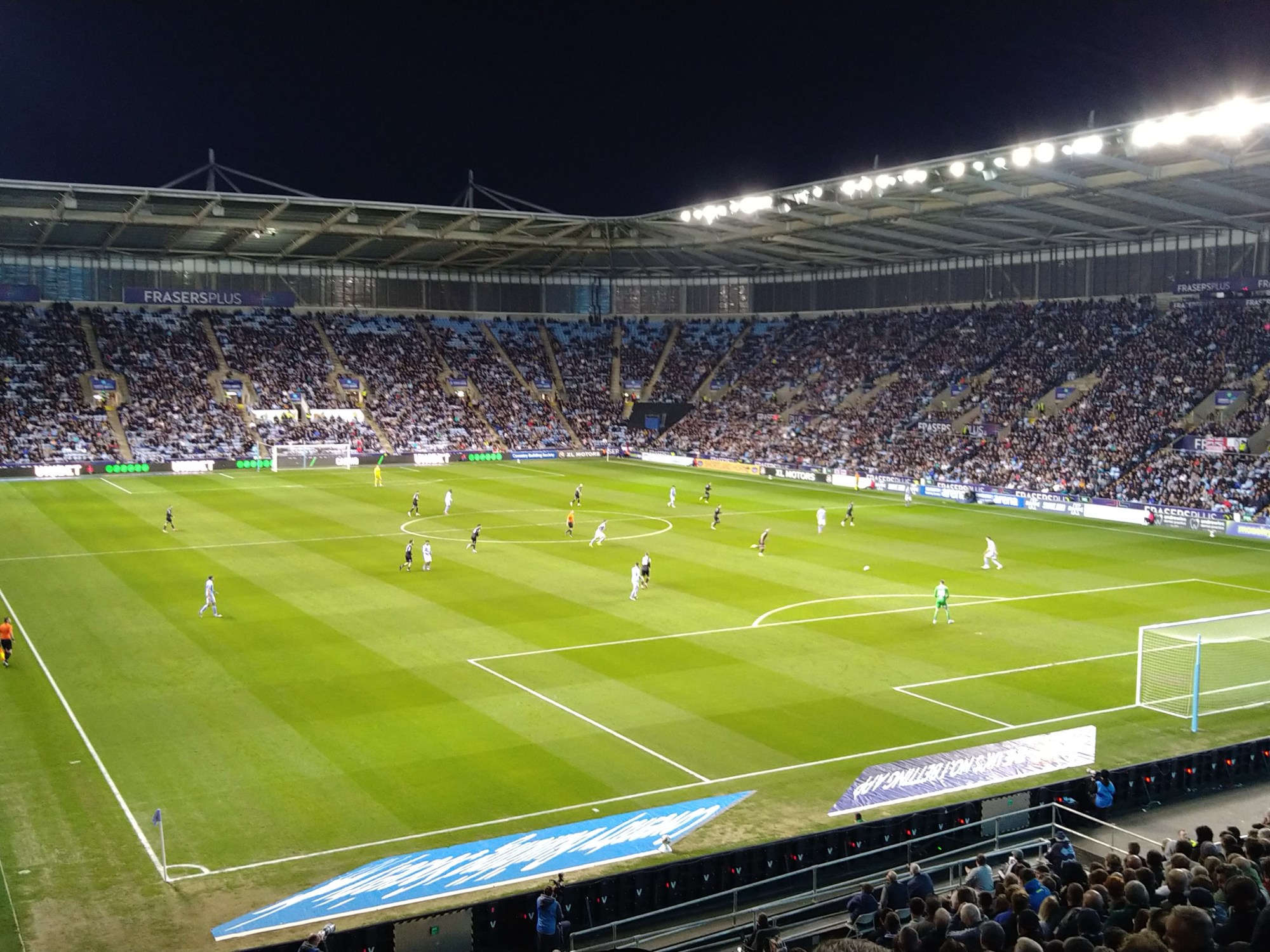
Coventry City v Pompey – Wednesday 9th April 2025
After Saturday’s late loss at Millwall, John Mousinho’s Pompey arrived in the West Midlands in 17th place, three points clear of the relegation zone (with a goal difference five better than 22nd place Cardiff) to face 7th place Coventry City who were a point outside the Play Off spots having dropped out of the top six on Saturday with their defeat at home to Burnley.
It is our first visit to the Coventry Building Society (CBS) Arena since a midweek game in September 2018 when we won by a Ronan Curtis goal to nil in League One. Our last match away to Coventry was the following season, just before the first Lockdown in February 2020 at Birmingham City’s St. Andrew’s stadium that Coventry had to share at the time. In that midweek game, the Sky Blues beat us 1-0 enroute to their League One title winning season.
I have seen Pompey play at the CBS on other previous league and cup matches we have won and lost and have joined my wife Ajit (originally from Cov herself) to see the Sky Blues in other games as well.
We made the short 20-mile journey across the M6 from Birmingham to take in a scenic tour of historic Coventry. But not before having a quick look in the CCFC Superstore at the CBS. I must say there was an impressive range of Cov retro shirts available. If I was a fan I would definitely get their iconic early 80s Talbot shirt. There was time for a couple of quick photos of us outside before heading to the Sky Blues’ former abode and some club history.
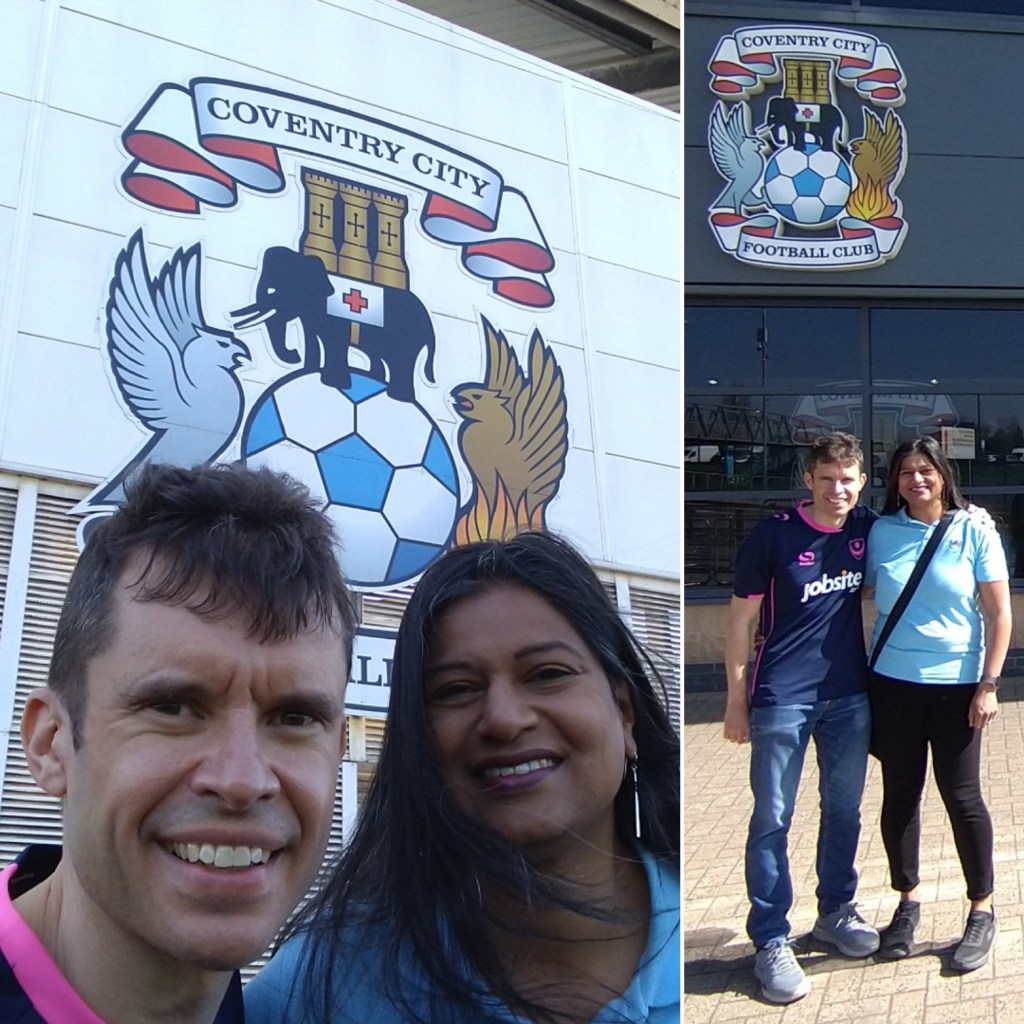
Derived from the Singer Cycle Company in the city in 1883, the football club were originally formed as Singers FC. As the club grew in popularity and rose through the Birmingham & District League, they were renamed Coventry City in 1888 and a year later moved to Highfield Road about a mile east of the city centre.
The club played here until 2005 and is surely best remembered from the Jimmy Hill revolution. In his six years as manager after taking charge in 1961, Hill reverted the club back to its traditional Sky Blue colours for the first time in 40 years and co-wrote an adaptation of the Eton Boating Song “Let’s All Sing Together…” that is still sung loud and proud by the Cov fans today. Plus the small matter of overseeing promotions from the third to first division (now League One to the Premier League) as the club recorded their record attendance of over 51k.
After establishing himself in broadcasting in the late 60s/early 70s, Hill returned to Coventry as Director then Chairman and made Highfield Road the first all seater stadium in 1981 before terracing was reinstalled a few years later. It was modernised after the Taylor report, most notably with a new all seater stand replacing the large uncovered Spion Kop terrace at one end.
I did manage to see Pompey here the once when we lost 2-0 in (what is now) the Championship in September 2001 before the Sky Blues relocated four years later.
It’s amazing to think that one of the 10 biggest cities in England with such an industrial heritage and so centrally located had to wait until 1967 to stage top flight football. Coventry would remain in the top flight for 34 consecutive seasons winning the FA Cup in 1987 and being a founder a member of the Premier League five years later.
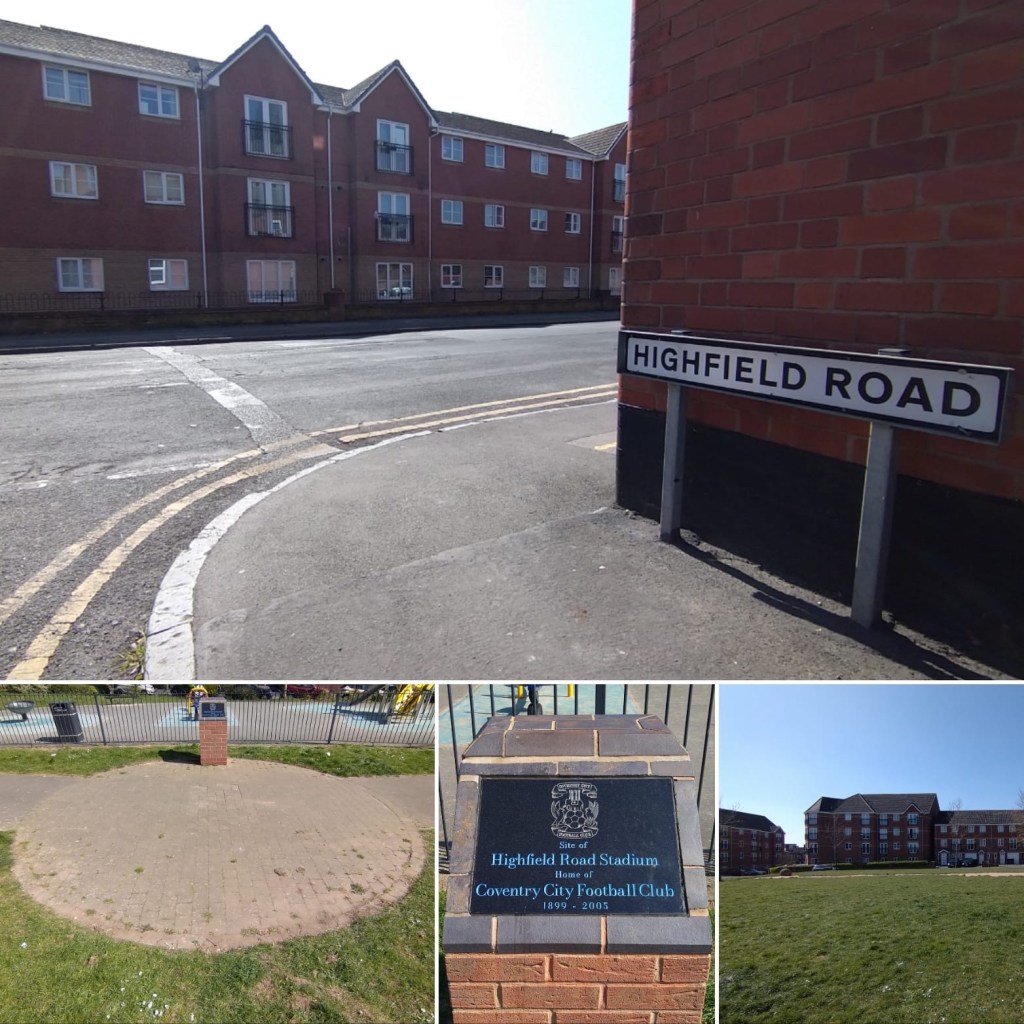
Despite new houses being built on the old ground, the site has incorporated a grass field and playpark where the pitch was. This includes a paved circular area to depict where the centre circle stood complete with a plaque to mark its former use.
It was time now to look around the city centre. Coventry is so often maligned and criminally underrated by outsiders looking in. Its incredible range of architectural history dating back to the medieval times right through to the modern day with countless hidden gems makes it so unique. Awarded the City of Culture for 2021, it’s a ‘must visit’ city in the same bracket as many other historic places people flock to in the UK.
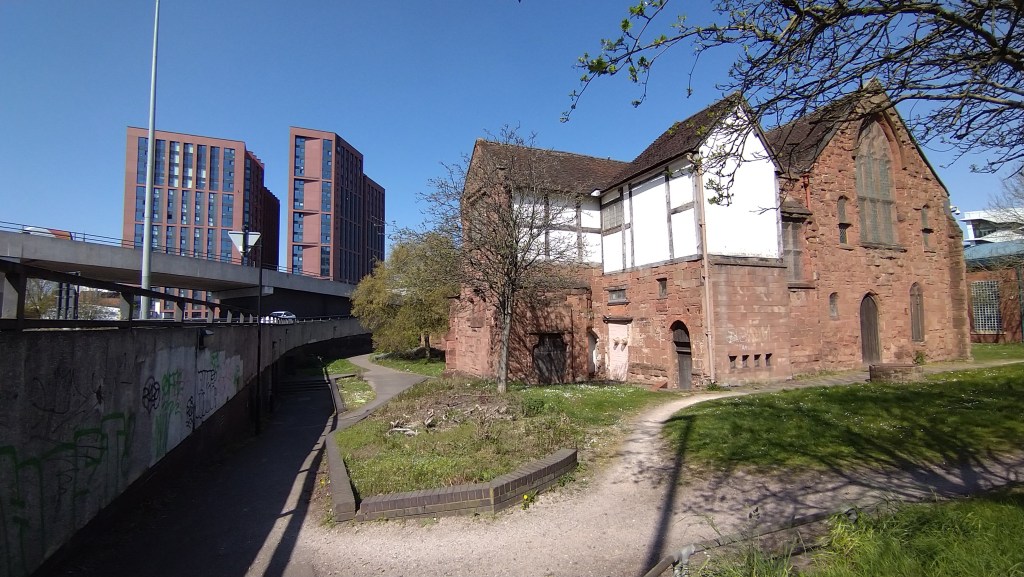
Just to the south east of the city centre is Whitefriars Monastery dating back to 1342. Pictured below arguably sets the scene for Coventry with its old and new mixture like no other. Where else would you see a medieval Monastery with a 1970s ring road flyover right in front of it and contemporary student tower blocks in the background?
Slightly further out of the centre off the London Road is Charterhouse Coventry. This grade i listed building from 1381 was originally a Carthusian monastery. It has since been privately owned with some famous occupants including Queen Elizabeth I. Nowadays, this is a National Trust Museum with history to be enjoyed on its three floors.
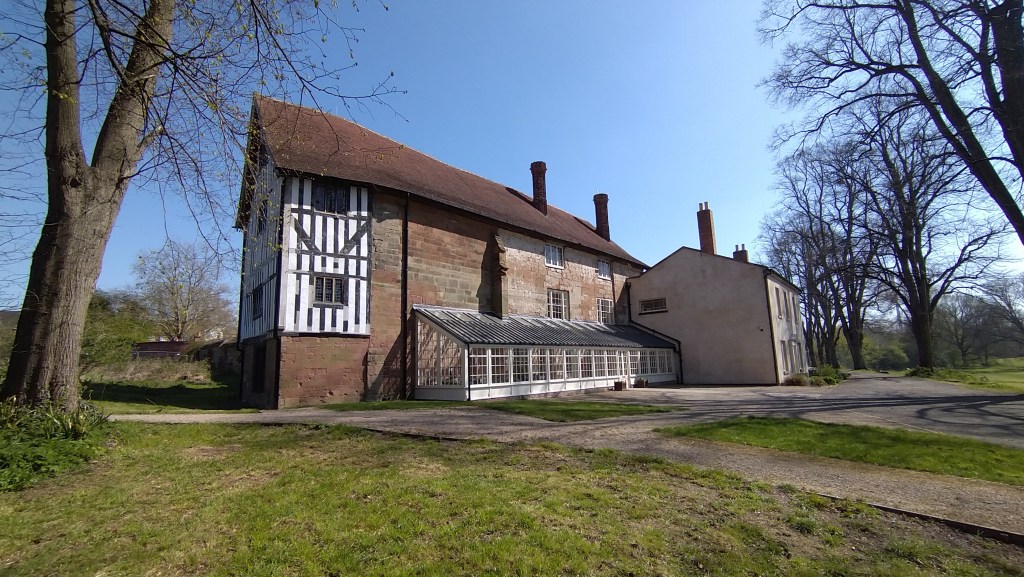
Along with its beautiful gardens, Charterhouse stands next to literally one of the city’s biggest hidden gems, the River Sherbourne.
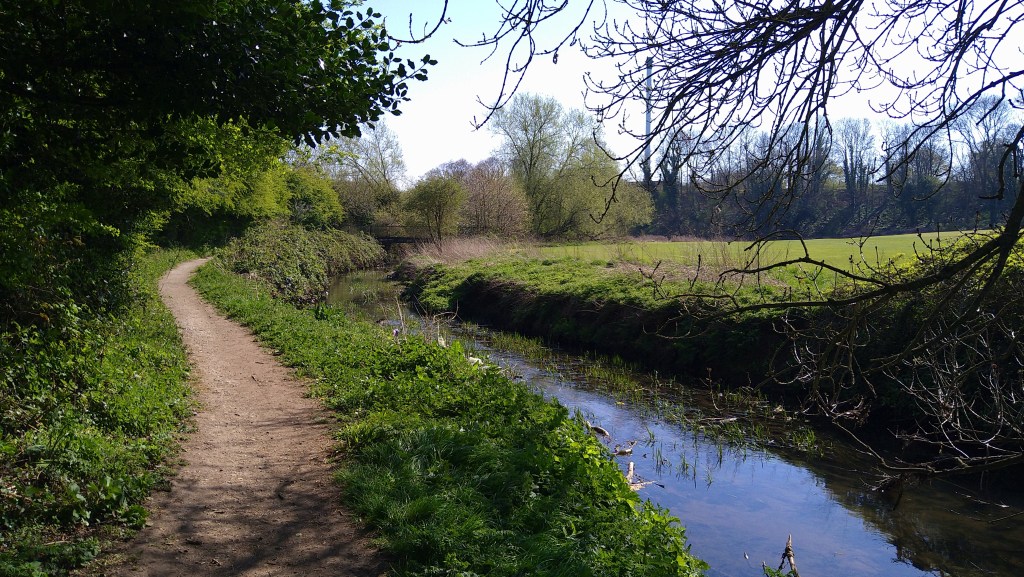
This eight-mile river flows through Coventry with one of its features being the grade ii listed Sherbourne Viaduct which transports trains on the Rugby–Birmingham–Stafford line.
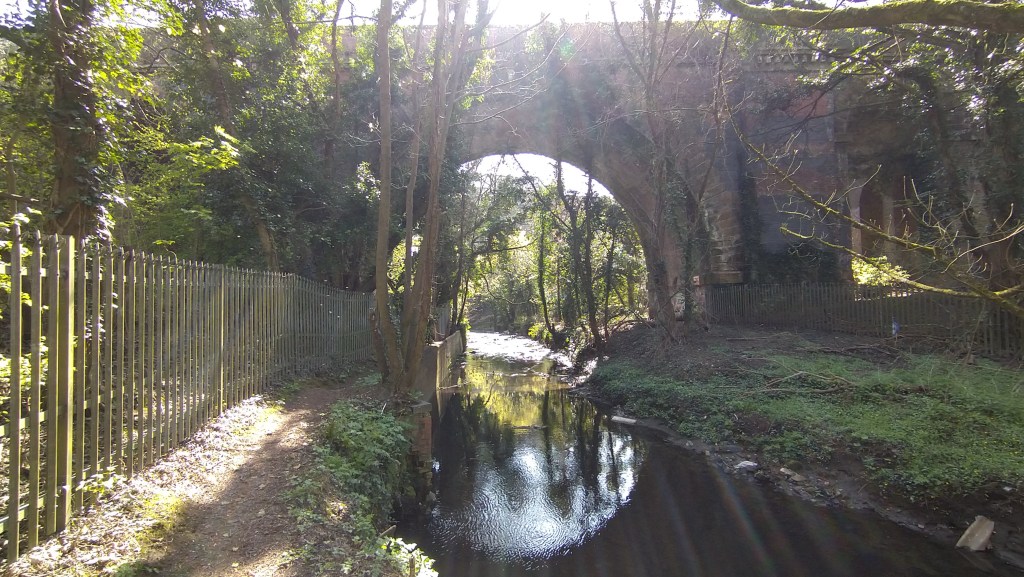
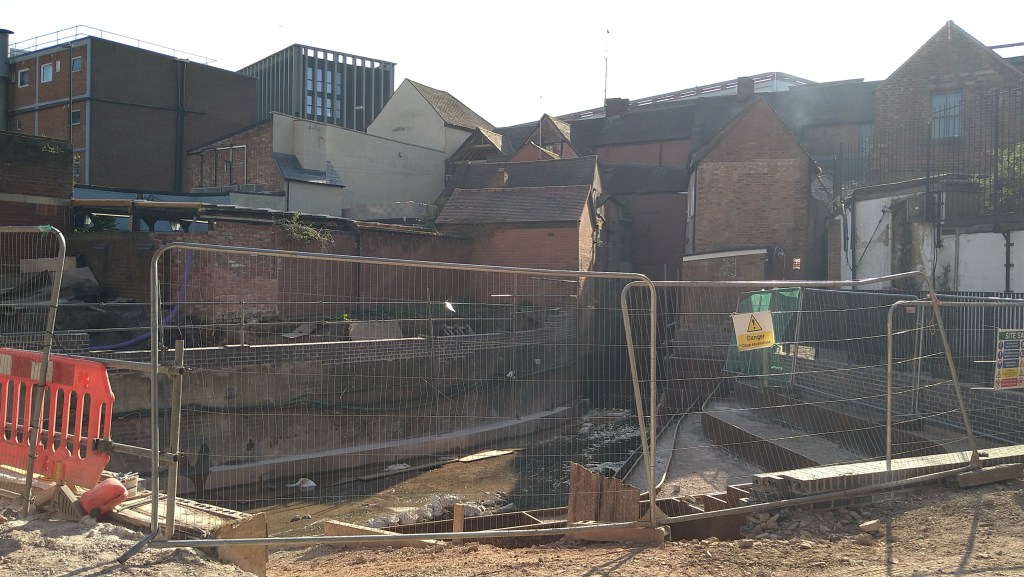
During the post war re-development of Coventry, the river was culverted off in the city centre which is a such shame as it would have been a lovely feature. But now so many people outside the city would not even know it exists. Although there are excavation works underway for a section of this in the city centre, more on that later on.
As mentioned earlier, there is such a concoction of buildings in the city centre. Owing to the many different types of factories in Coventry and how key they were in WW2, it is well documented how heavily bombed it was, with the city centre a near blank canvas for post-war architecture with a number of streets also realigned as the phoenix rose from the ashes.
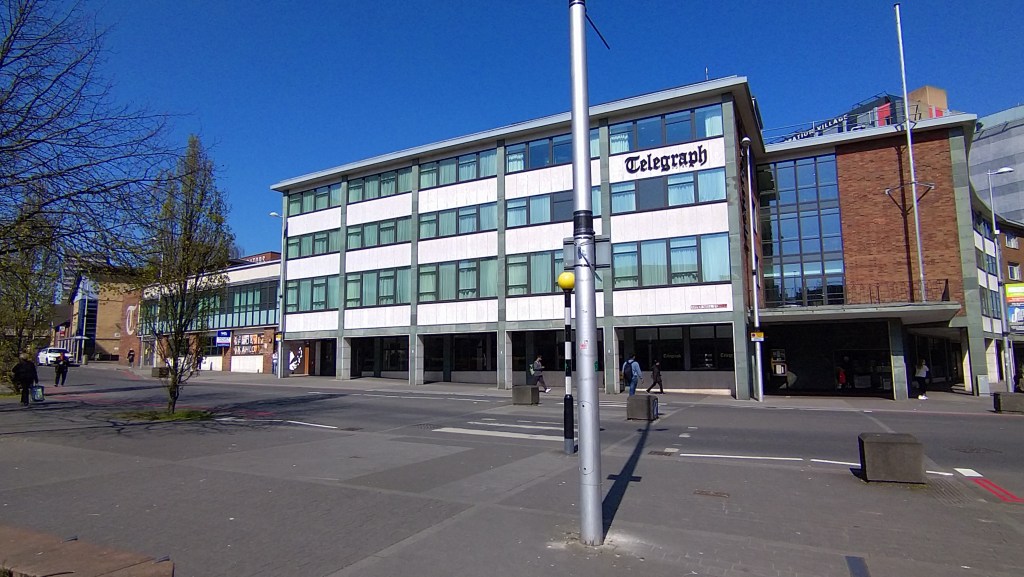
One such example is the former home of the city’s newspaper Coventry Telegraph on the corner of Corporation Street and Upper Well Street. Built in 1959, in recent years it has been transformed into the Telegraph Hotel and ran by Bespoke Hotels.
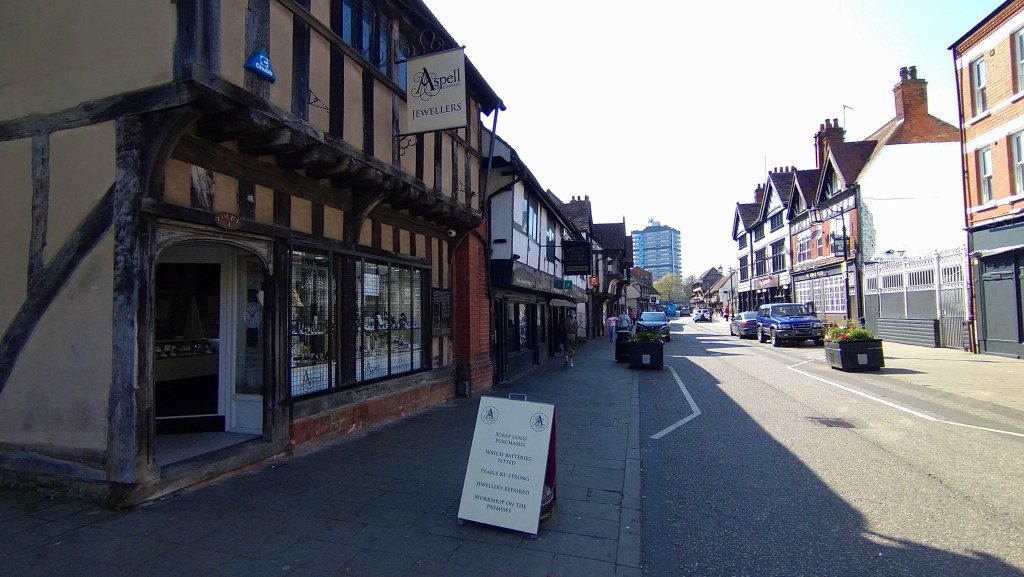
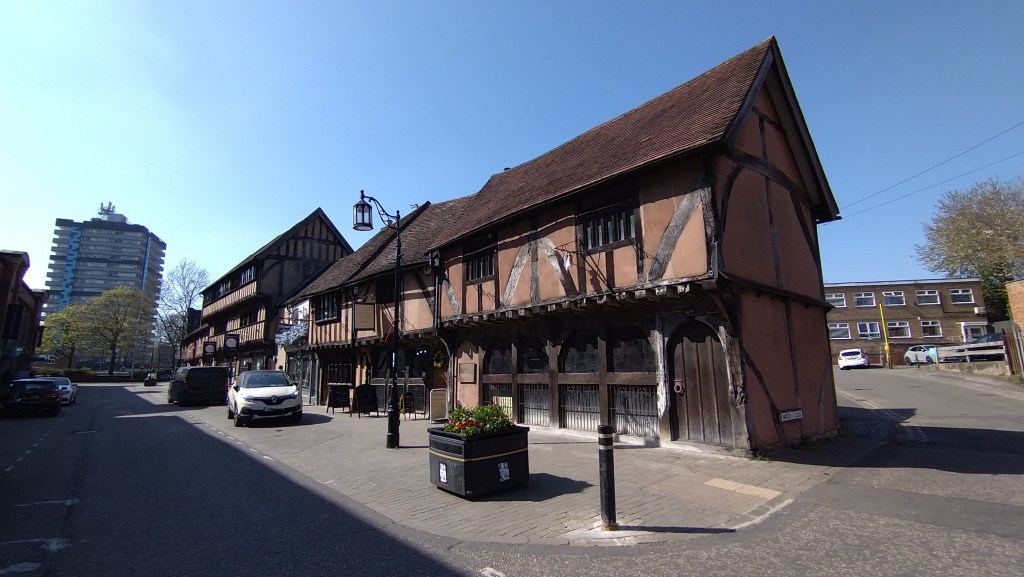
Prior to WW2, much of Coventry city centre was steeped in medieval history where some of the timber buildings thankfully survived. Then in the late 1960s and early 1970s, a clever cut and paste exercise took place to move some of these from elsewhere to add to the remaining ones in Spon Street to depict how this iconic street (and many others in the city centre) would once have looked.
After cutting through Lower Precinct Shopping Centre into the main retail hub of the city, it is here there are so many parallels with our own city centre. Pictured from Market Way facing Upper Precinct reminds of a cross between Commercial Road in Portsmouth (with the fountain as its focal point) and Palmerston Road in Southsea for its post war architecture.

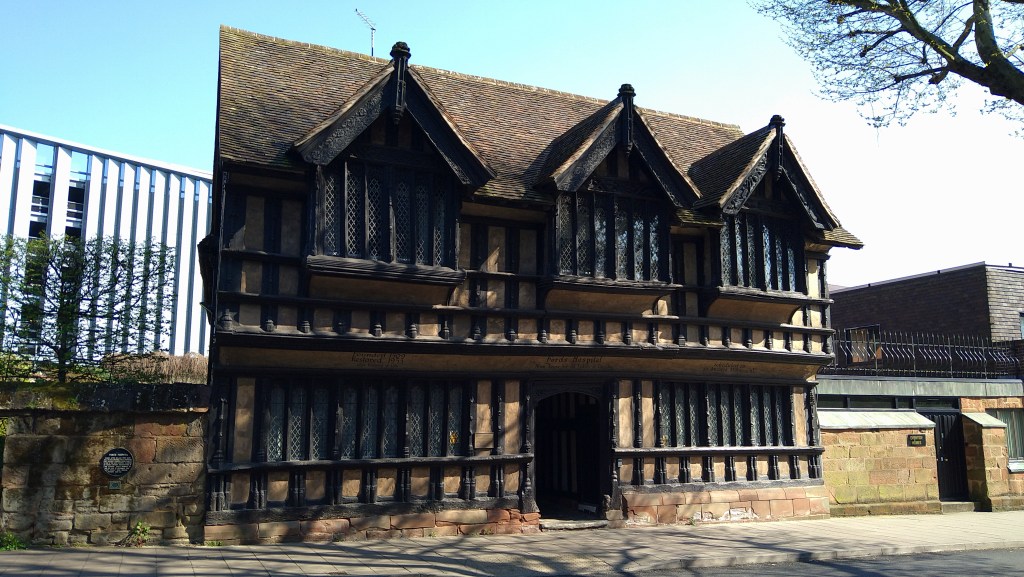
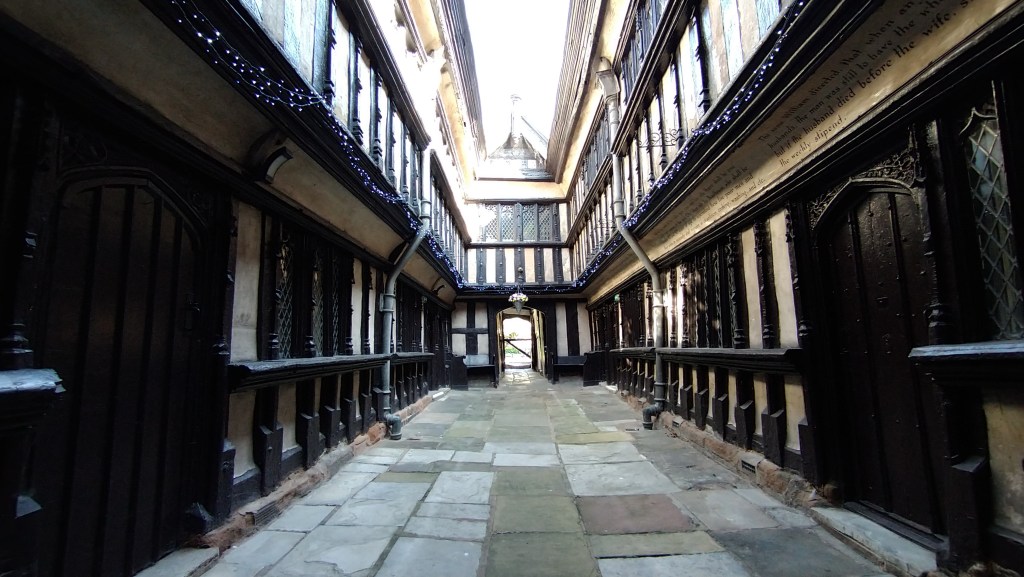
One of the timber builds in Coventry that suffered damage in WW2 but was repaired is the grade i listed Fords Hospital Alms House on Greyfriars Lane built during the Early Modern period of 1509 with a narrow court yard running through the middle.
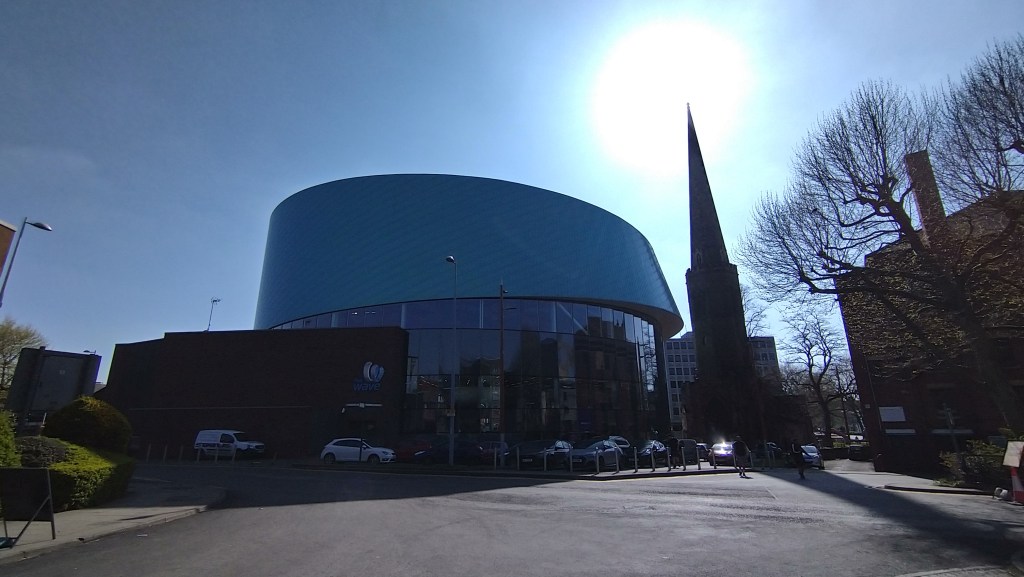
Around the corner from here on New Union Street as pictured below is the round shaped turquoise building which is the indoor water park called The Wave that opened in 2019. Then next door to it is one of the city’s famous three spires, Christ Church (Greyfriars) . More on the other two spires later.
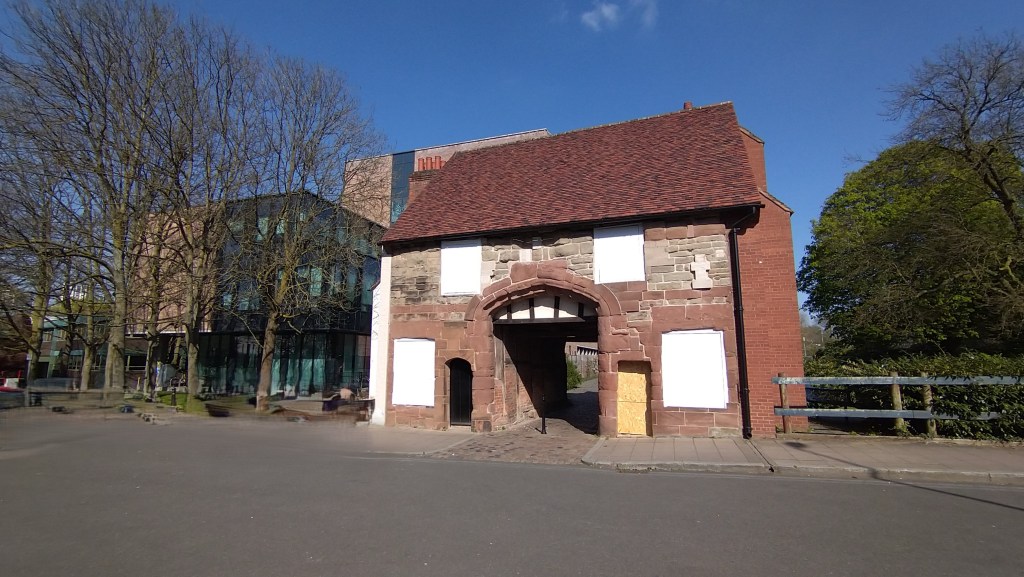
Over in Much Park Street is the grade ii listed 14th century Whitefriars Gatehouse which, as the name would suggest, was the entrance to Whitefriars Monestry (pictured earlier on the opposite side of the ring road).
Known locally as the Toy Museum as the building was used for this purpose for over 45 years until the much loved museum owner Ron Morgan passed away. Sadly this wonderful old building has stood empty ever since and is on Historic England’s Heritage at Risk Register. Although there are plans to turn this into luxury holiday accommodation.
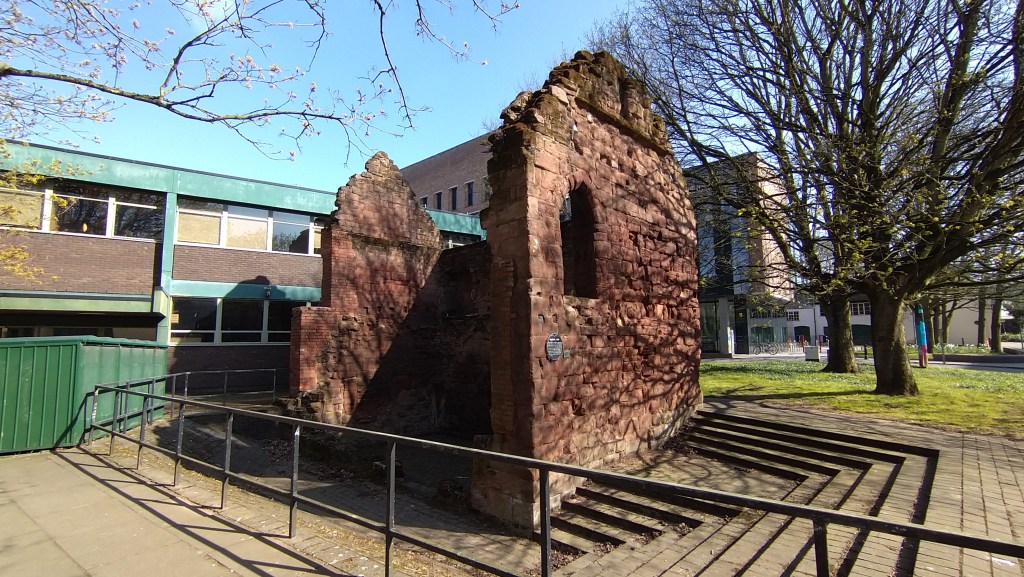
Near to this on Much Park Street is a medeival ruin which ironically was discovered due to WW2. Unearthed in 1971, it is still to be determined what this was used for. Although its plaque seems to suggest a merchants house or possibly some connection to Whitefriars itself.
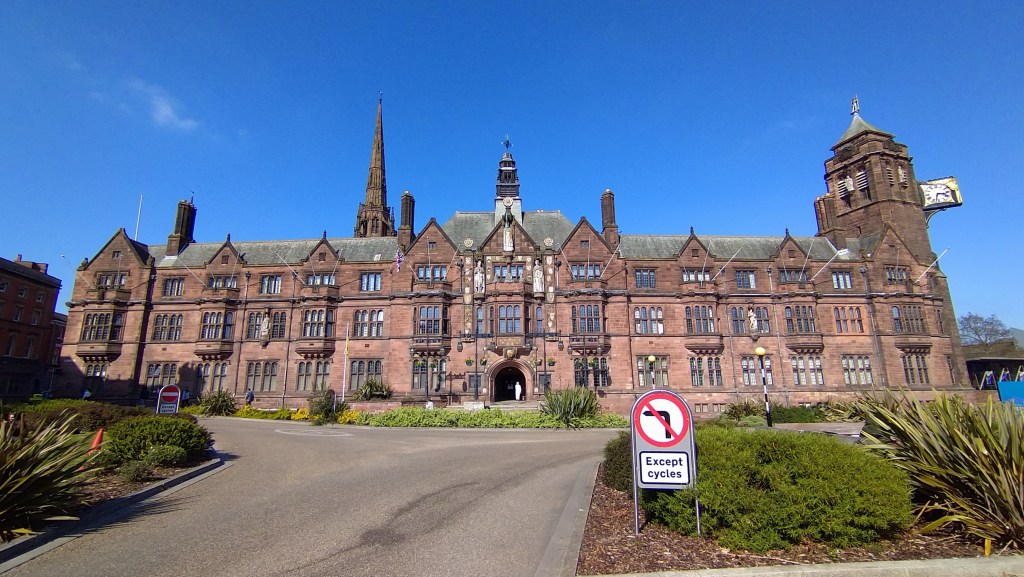
On Earl Street is the fabulous looking Council House which opened in 1917.
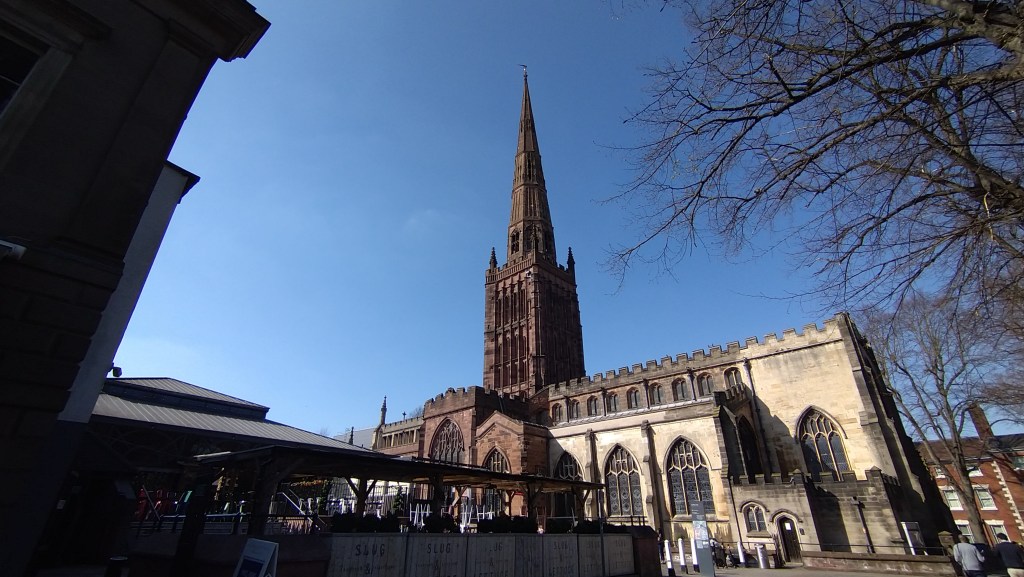
A couple of blocks behind here is one of the other three spires I mentioned earlier, Holy Trinity Church on Priory Row with the most recent version buiilt in 1667 as pictured below.
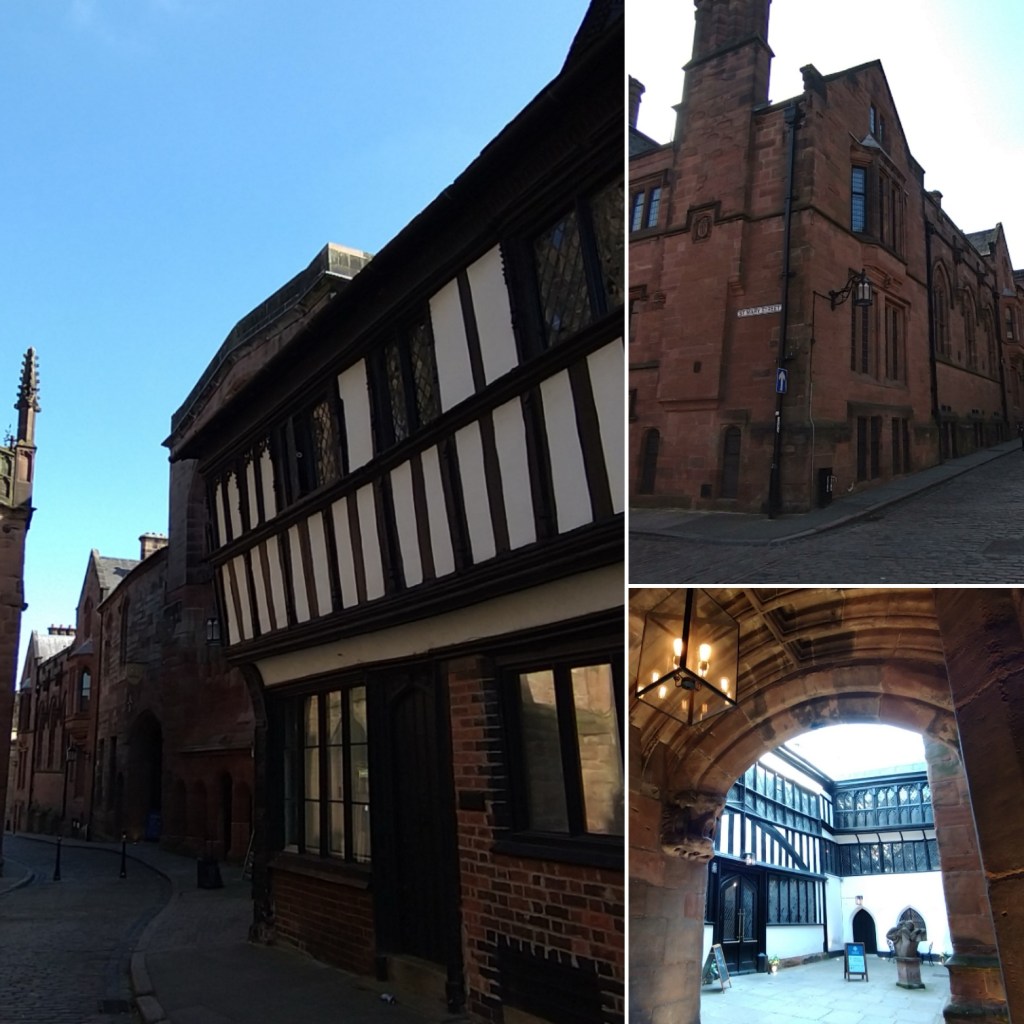
Around the other side of the Council House on Bayley Lane is the medieval grade i listed St Mary’s Guildhall as pictured in the collage below.
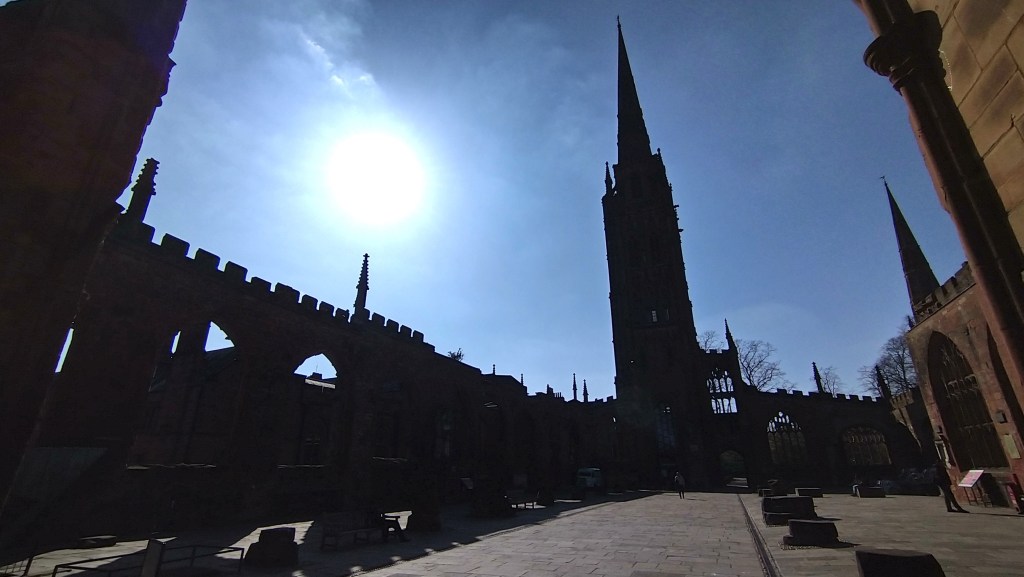
While on the other side of Bayley Lane is the third of the three spires in the city and a building that defines Coventry’s 20th century history.
As well as Coventry being targeted in WW2 for its manufacturing infrastructure, it was also considered to be a morale bombing. None more so than the devasting raid on 14th November 1940 when around 33 thousand incendary bombs were dropped on the city, destroying over 4,300 homes and killing over 500 civilians with even more seriously injured.
This included the destruction of the city’s most iconic landmark – the gothic medieval St Michael’s Cathedral. Such was the devastation that King George VI visited the cathedral and the city two days later to pay his respects and raise morale in the war torn city.
Amazingly the cathdral shell and its tower and spire all survived. Having enjoyed the views from the top of the 180 step climb up the up the tower on previous visits, I had hoped to photograph these again. But the tower climb doesn’t re-open to the public until Easter Sunday.
There is also the fascinating Blitz Museum at the other end of the ruin. Complete with all kinds of artefacts, it depicts both a typical school room and a house in the city during that fateful night in 1940. Although as this only open at weekends, it is a visit for another time.
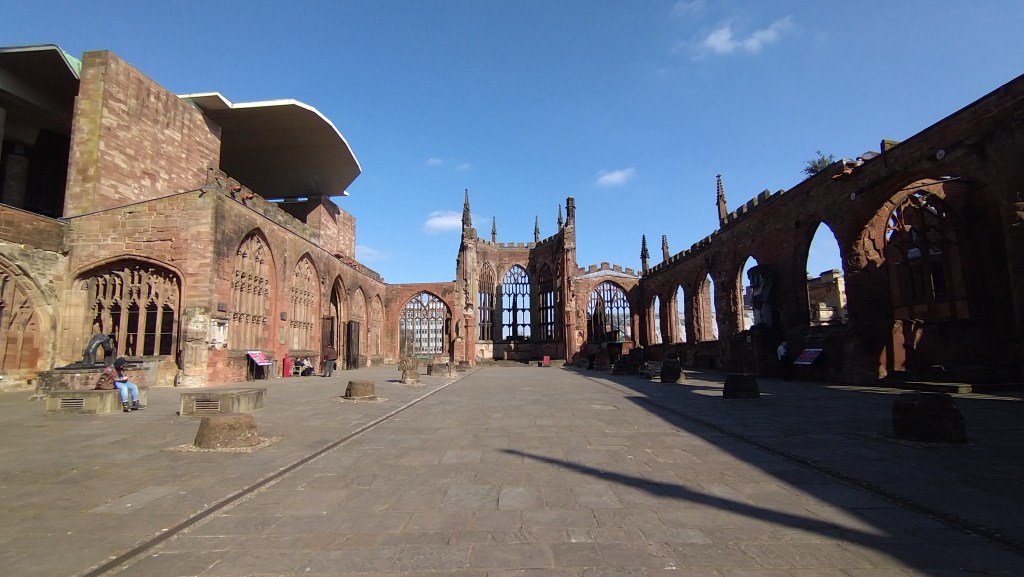
Behind where the altar would have stood are the words ‘Father Forgive’ enscribed here just after WW2. This stemmed from the then cathedral Provost writing this in chalk as the rubble was still smouldering. Then in an incredibly symbolic irony, two of the roof beams that were heavily charred had fallen in the shape of a cross and were placed where the destoyed altar stood, with a replica of this cross now in place.
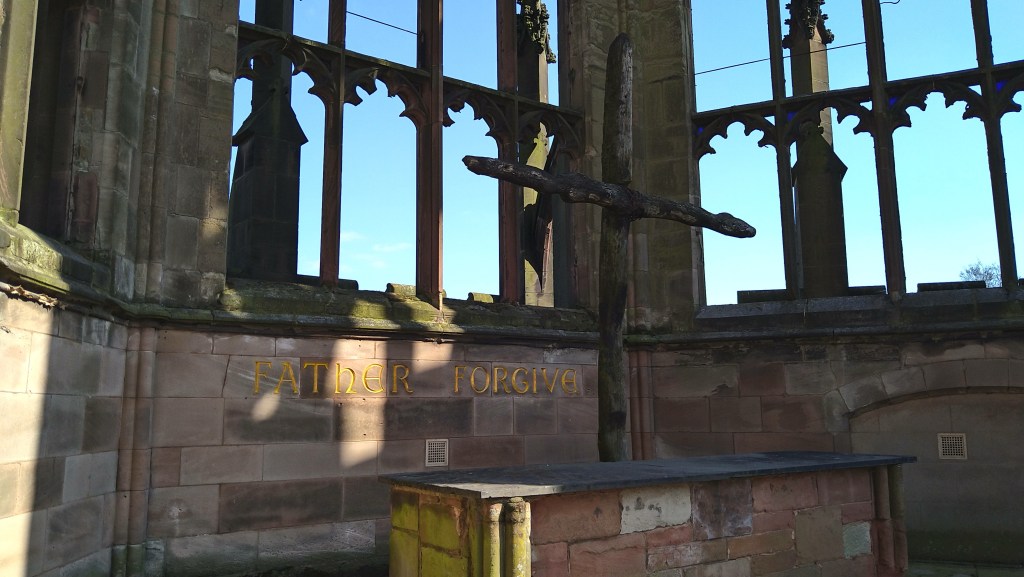
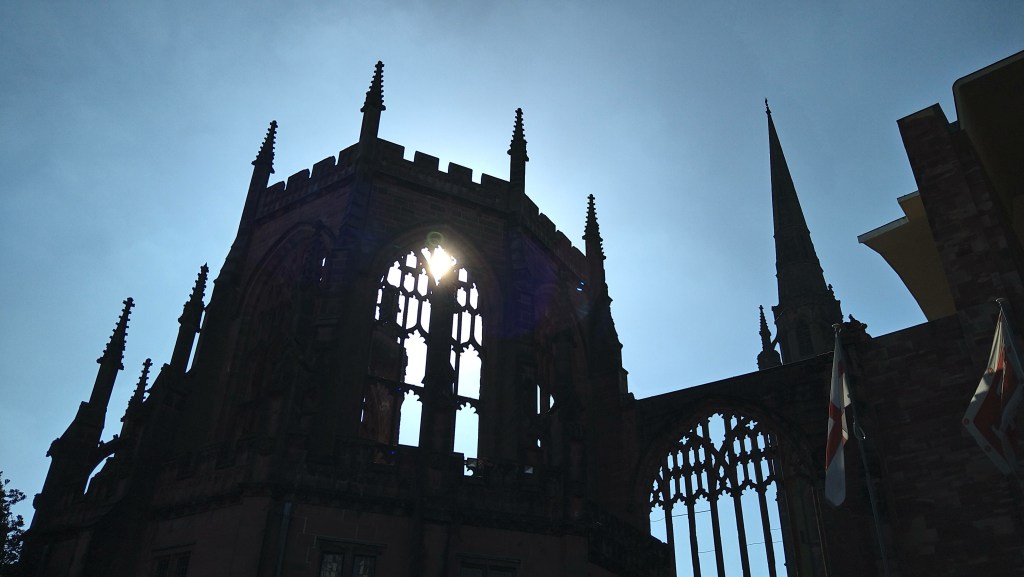
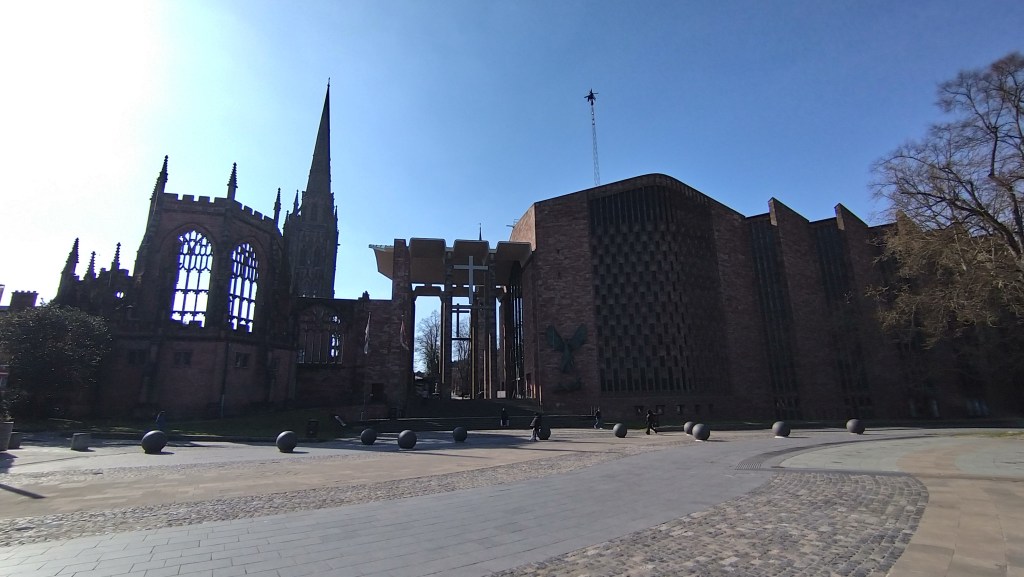
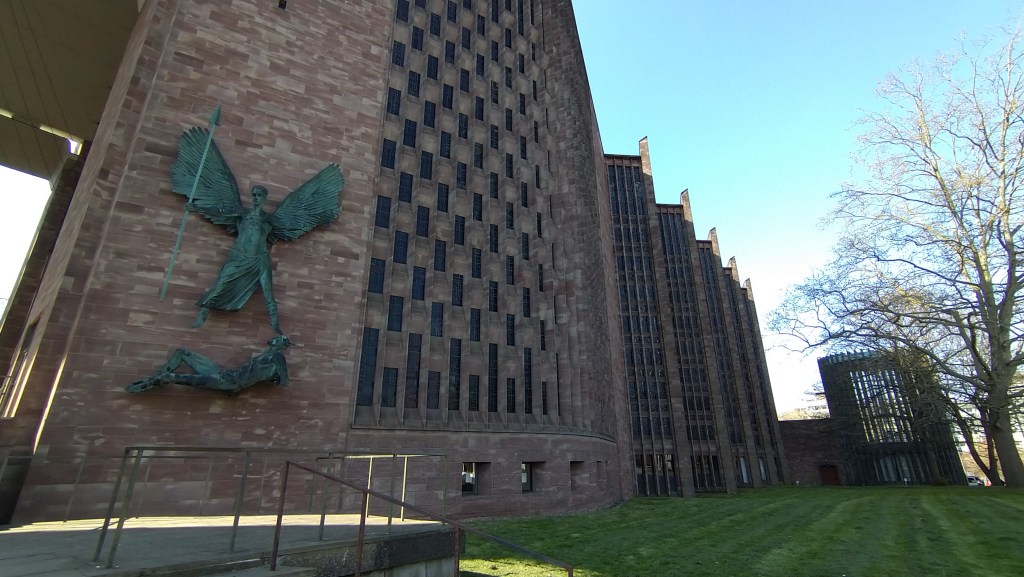
Instead of rebuilding it, the cathedral was left as a ruin and adjacent to it a new modernist design opened in 1962 with its adjoining roof to the ruin. On the outside is the St Michael’s Victory over the Devil bronze sculpture to to symbolize the victory of good over evil. With both the history and contrasting architecture of these cathedrals, it is always such a talking point for any visitors.
The new cathedral is so impressive inside with the undoubted key feature being the beautiful Baptistery Window that consists of 198 stained glass panels at a height of 26 metres, with the font underneath from a rough boulder brought in from Bethlehem in 1960.
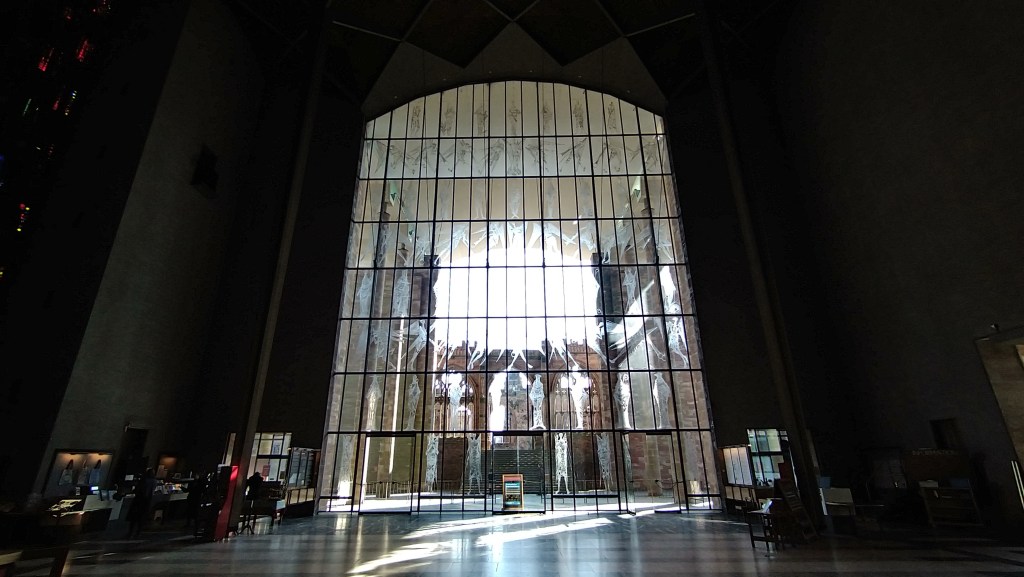
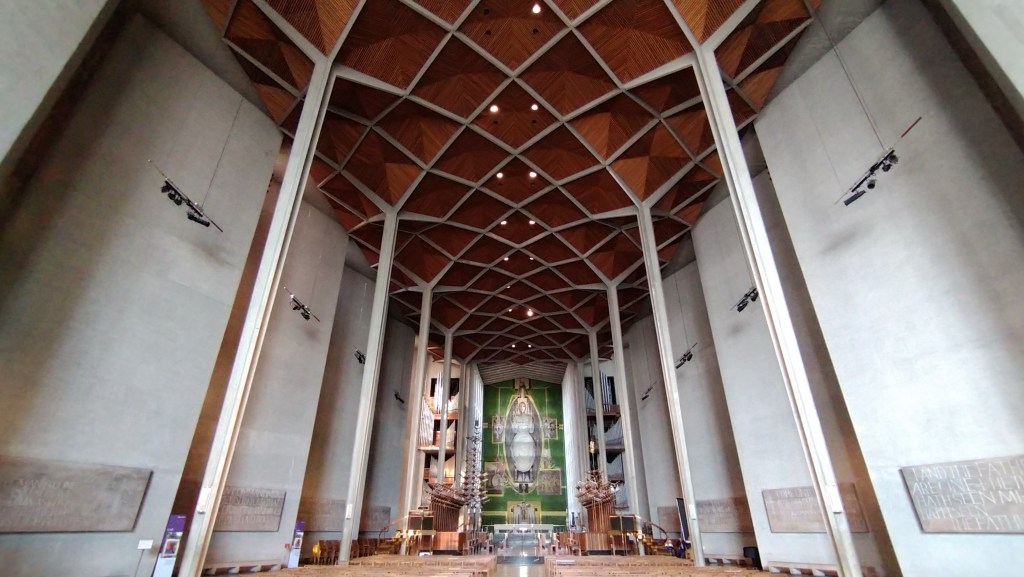
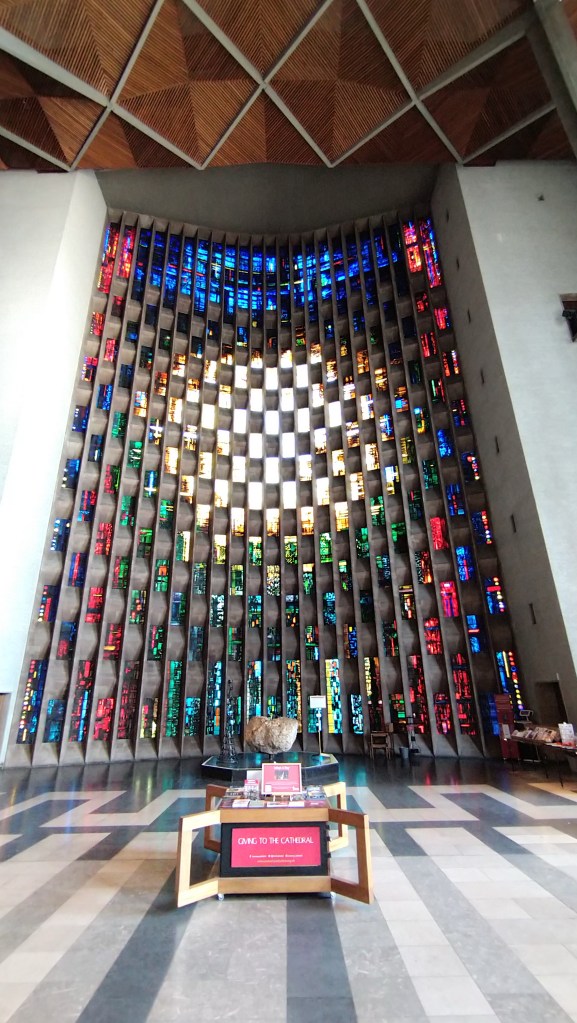
Just around the corner from the cathedral is Broadgate which is at the very heart of the city centre. At the northern end of this is a 70s replica of the medieval market cross with the Lychgate Cottages to the right from the early 15th century.
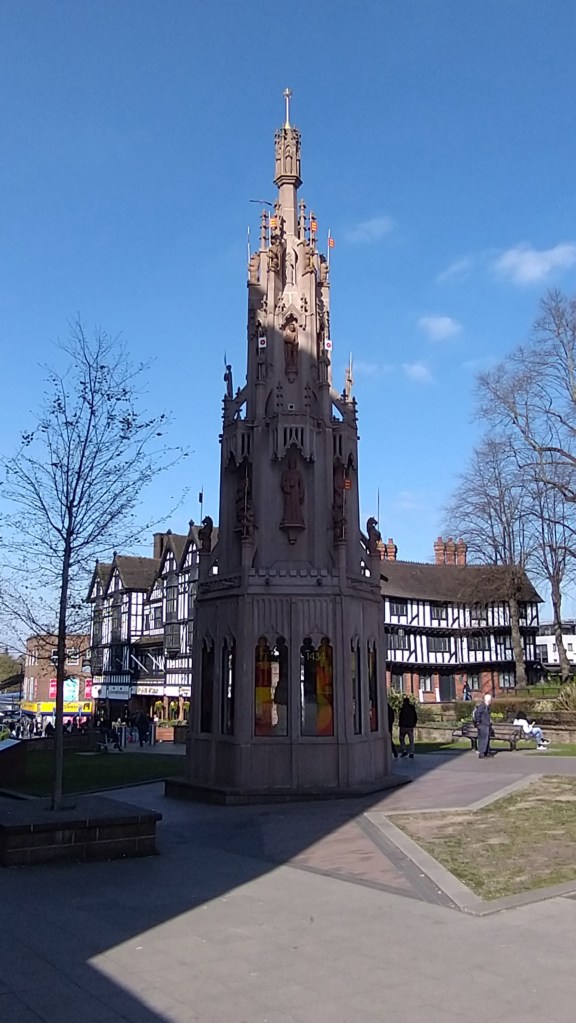
In the middle of Broadgate is arguably the biggest focal point in the city centre, the ‘Self Sacrifice’ (AKA Lady Godiva) statue.

Legend has it that she rode through Coventry on the back of a horse naked in 1040 as a protest to her husband Leofric, the Earl of Mercia and Lord of Coventry whose heavy taxes she thought was halting Coventry’s development.
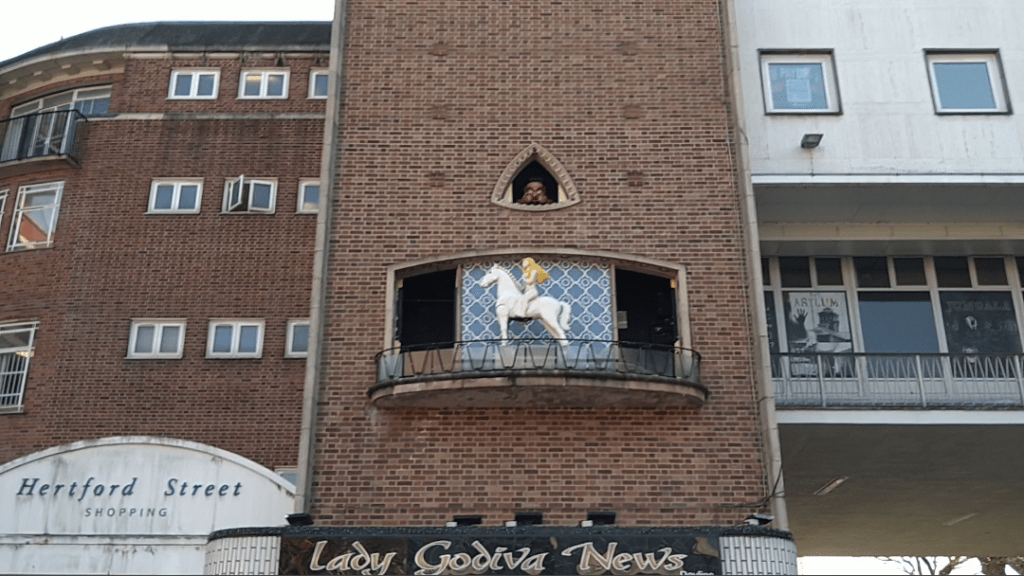
Our timing in Brodgate worked perfectly to watch a mechanism that depicts another part of the legend -Lady Godiva bell clock and Peeping Tom. On each hour, Lady Godiva comes out of the right hand door on her horse and back into the left hand door under the watchful gaze of the Peeping Tom who pops out of the wall above. This depicts a local tailor who defied orders for people to revert their eyes during her naked ride through the city
If ever there was a bold and quirky way to fill in spare land it is the building pictured below. After the city’s grade ii listed central baths on Fairfax Street were opened in 1966 and the ring road constructed six years later, this left a void on Cox Street. Step forward the Elephant building in reference to Coventry’s coat of arms built over the top of this street with a walkway to the baths.
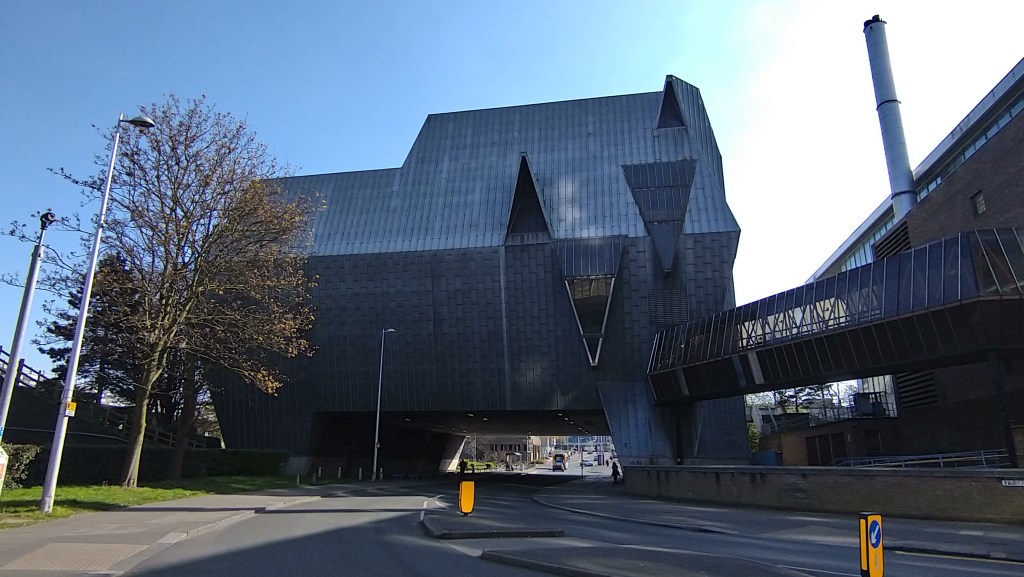
Sadly, the central baths closed in 2020 and the future remains uncertain for them and the Elephant building. I personally hope both can be retained and repurposed.
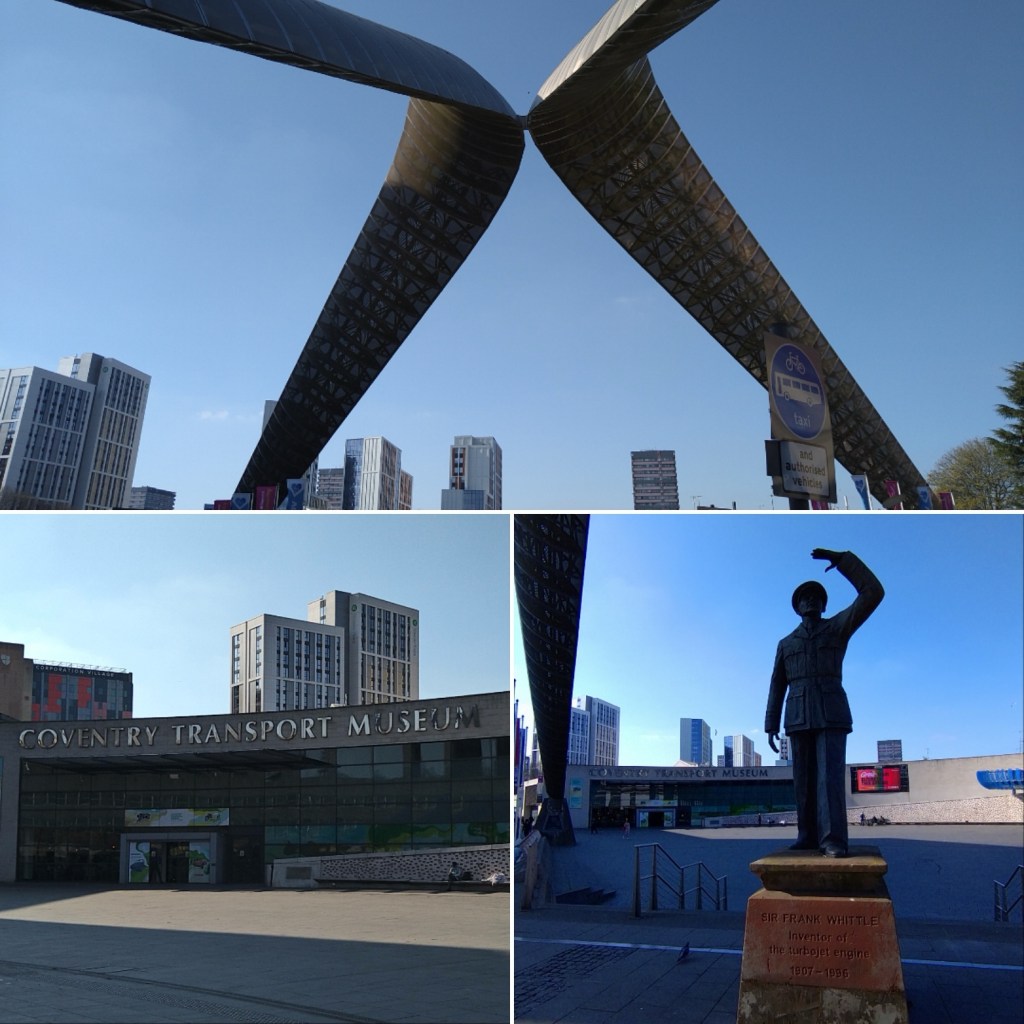
A few minutes along from here on Fairfax Street is Millenium Place which opened in 2003. Pictured in the collage below is the Whittle Arch opened in memory of Coventrian Sir Frank Whittle who invented the Turbojet engine, his statue and the Coventry Transport Museum relocated here from the Herbert Art Gallery in 2015.
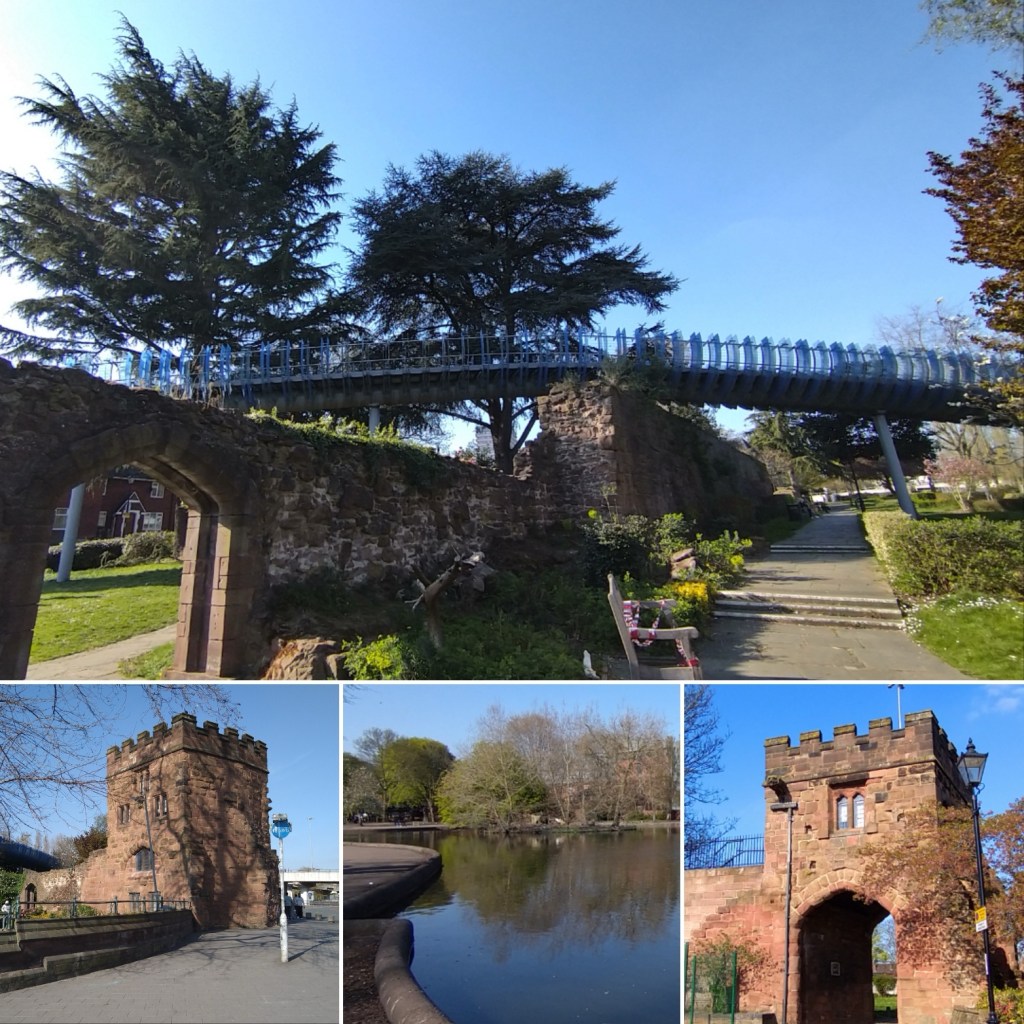
Next to this modern-day redevelopment is another example of old and new side by side in the city centre. Unsurprisingly, Coventry once had a city wall around the centre in not too dissimilar a footprint to where the ring road now stands.
During the English civil war in the mid-17th century, Coventry was a Parliamentarian city. In 1662 after the war had finished, King Charles II ordered the walls to be demolished to prevent any further revolts. Although it has been suggested this was also a form of revenge. Thankfully part of the city wall still remains next to Millenium Place with two of its twelve original gates.
Pictured in the collage below are the city walls in Lady Herbert Gardens (which you can walk over on the glass bridge) and L-R: Swanswell Gate, Swanswell Pool, Cook Street Gate.
I mentioned earlier about the River Sherbourne being culverted off in the post war years. Work is now in progress to re-open part of it in the city centre. As pictured below, it will have a lovely riverside patio with further greenery to be added.
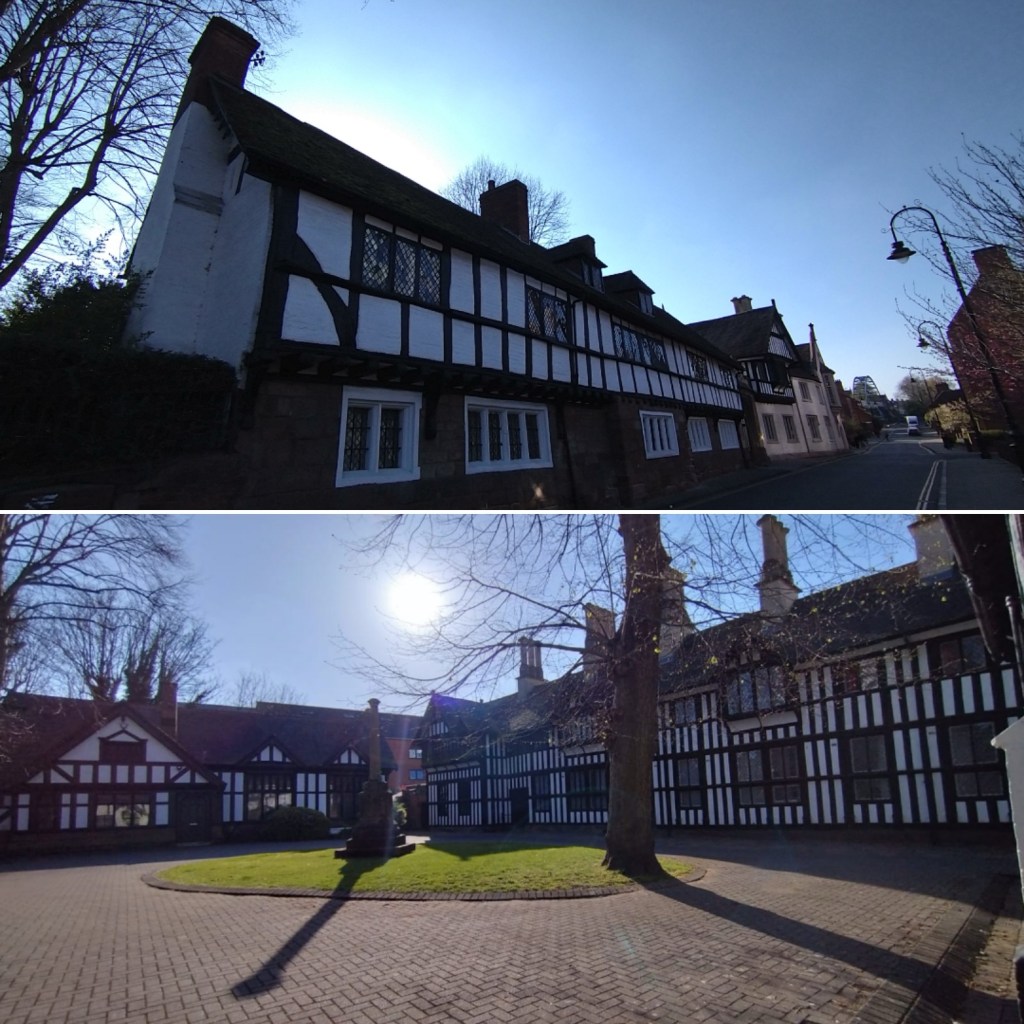
Finally, we passed by The College of Bablake and Bond’s Hospital on Hill Street which dates back to 1506 and part of it as long ago as 1344 where these college buildings, as pictured in the collage below, were part of the adjacent St John the Baptist Church.
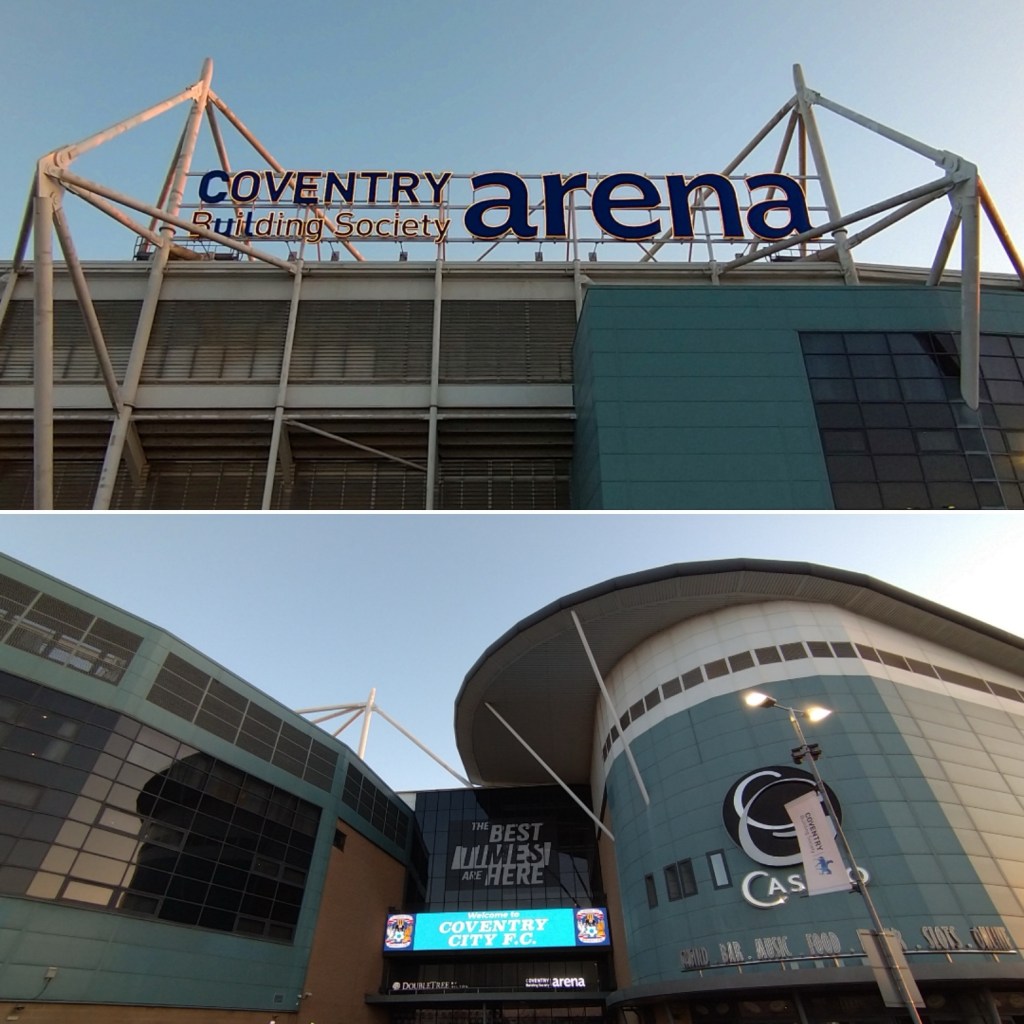
After catching up with Ajit’s parents and our pre-match dinner, it was time to make our way to the CBS Arena. Opened in 2005, the purpose built multi use complex comprises of the 32k capacity stadium, the adjoining Indoor Arena that holds 8k, the Grosvenor Casino, the Hilton Doubletree hotel which overlooks the pitch and the Coventry Arena railway station.
As well as part of the adjoining A444 linking the city centre to the M6 being renamed Jimmy Hill Way, there is of course a statue of the Sky Blue and broadcasting legend himself outside the aptly named stadium bar ‘The Anecdote’.

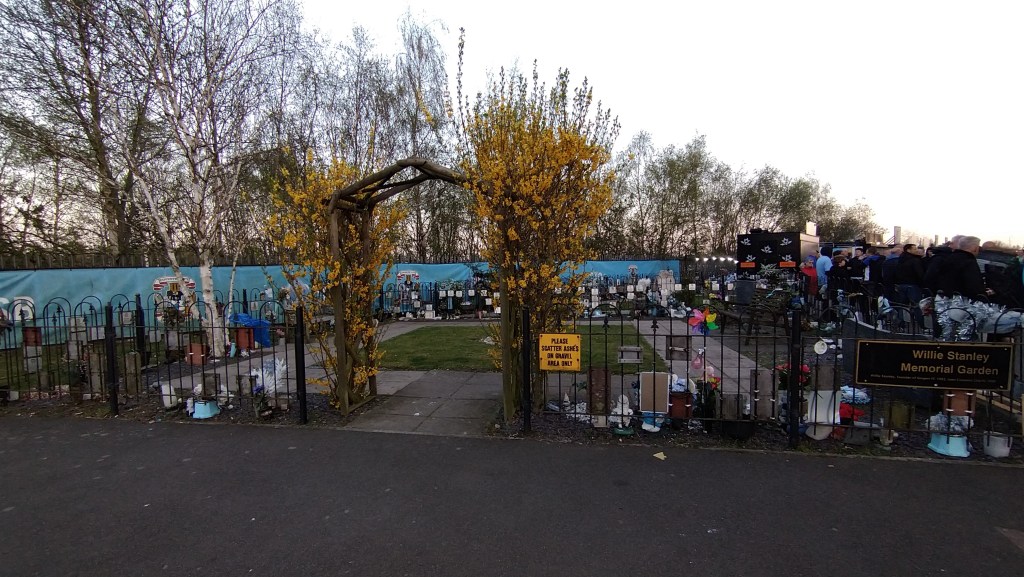
To the north east corner of the stadium is the club’s Willie Stanley Memorial Garden where Sky Blues fans can visit to remember fellow fans who were close to them.
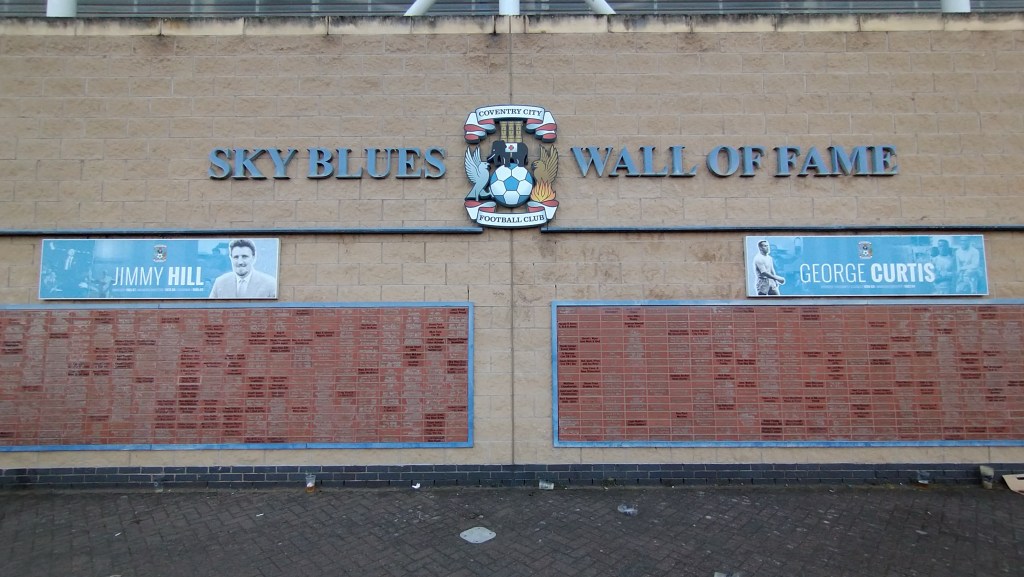
With me and Ajit in opposite ends for this game, there was still time for me to walk around the rest of the stadium. Behind the East Stand is a fan zone with plenty of fast food vans, music and the Sky Blues Wall of Fame where Cov fans can have their names etched into the bricks.
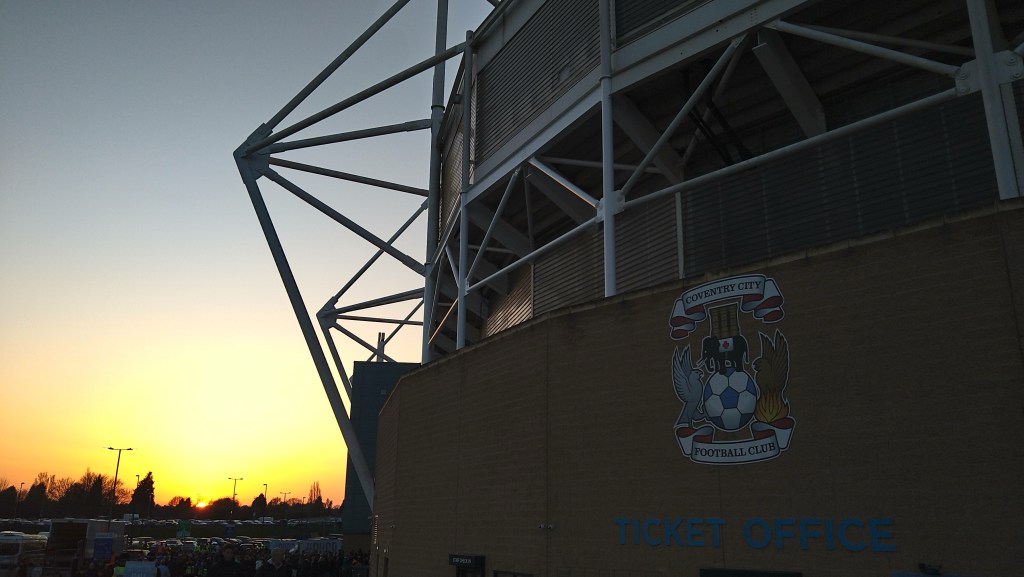
Just before the away turnstiles was a spectacular sunset that was well worth a photograph as I made my way into the stadium.
Inside the stadium it is very impressive with a single tiered bowl on three sides and the two-tiered West Stand on my left adjoining the hotel and executive facilities.
Last summer, rail seating was added to the upper areas of the away seats in the South Stand and in the other side of this stand on my right in ‘Singer’s Corner’. A play on words both for where Coventry’s vocal section congregate and the club’s historic name as mentioned earlier.
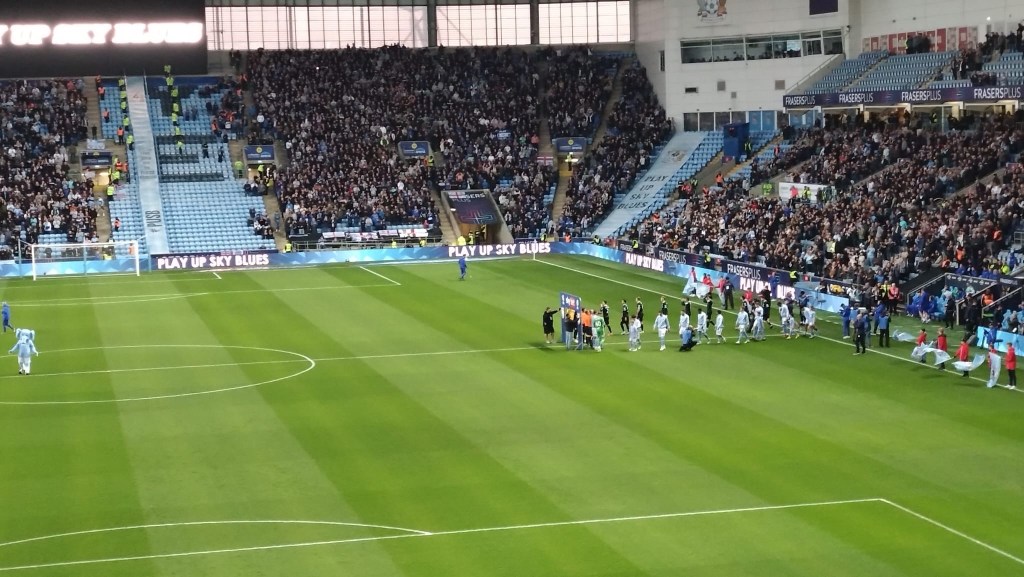
There was a great pre-match atmosphere from both sets of fans desperate for the points. The Pompey Chimes and We’ll Live And Die In These Towns (track by Coventry Indie band The Enemy) swept across the stadium as the players made their way out for kick off.
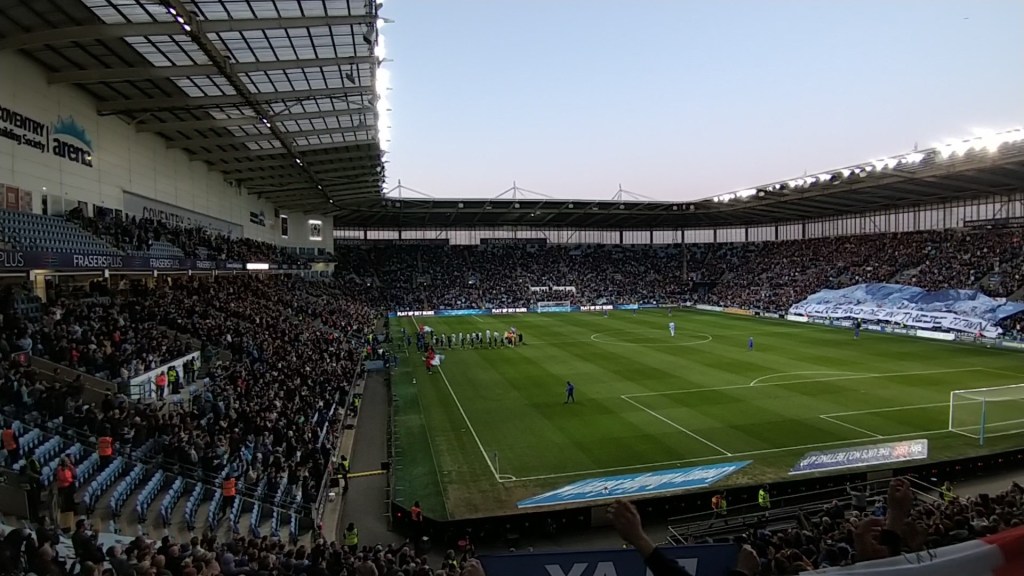
Pictured below is the photo Ajit took from the opposite North Stand of the players’ handshakes, our fans and of course Sky Blue Sam (Coventry’s elephant mascot) on the far left.
As Pompey kicked off, they attacked as if they were the home side desperate for the points and 4 minutes in had a chance when Adil Aouchiche intercepted Victor Torp’s square pass. But his low shot from outside the box was dealt with comfortably by keeper Bradley Collins. Then five minutes later, a decent through ball from Ogilvie was controlled by Josh Murphy before forcing the Coventry defence to get in another block. Pompey were clearly on the front foot and not there just to park the bus.
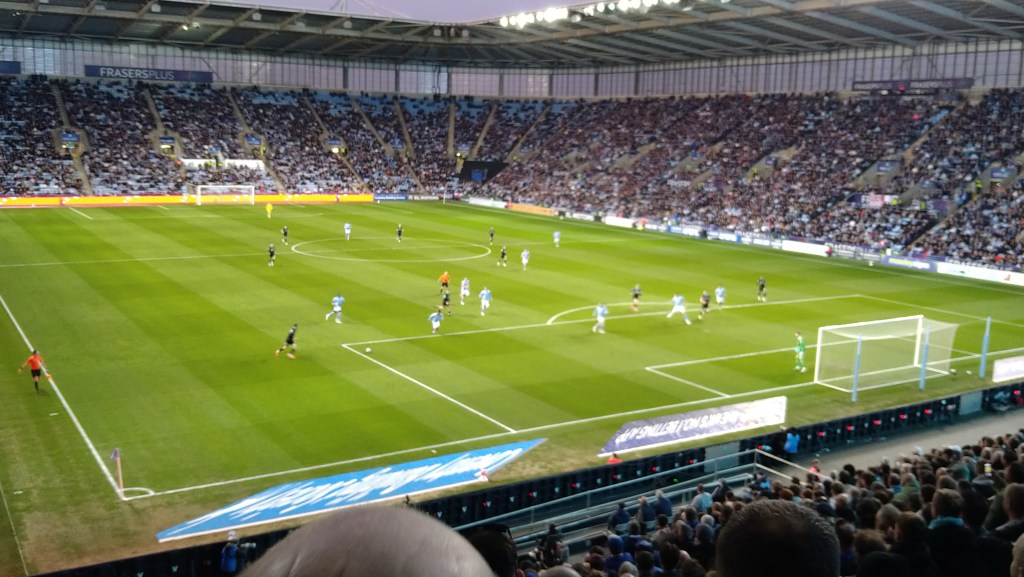
But on 15 minutes, we survived a Coventry penalty appeal where Matt Grimes lofted a great diagonal ball out to Tatsuhiro Sakamoto who brought the ball down well, ran into space before unleashing a shot that hit Andre Dozzell on the arm and then hand to much appeal from the home players and their fans in vain. There were ironic cries of ‘hand ball’ from the Pompey fans after, but with no VAR in the Championship it seems from the replay that might have been fortunate. Minutes later, Torp sadly had to be stretchered off after twisting his ankle with Ben Sheaf replacing him in midfield.

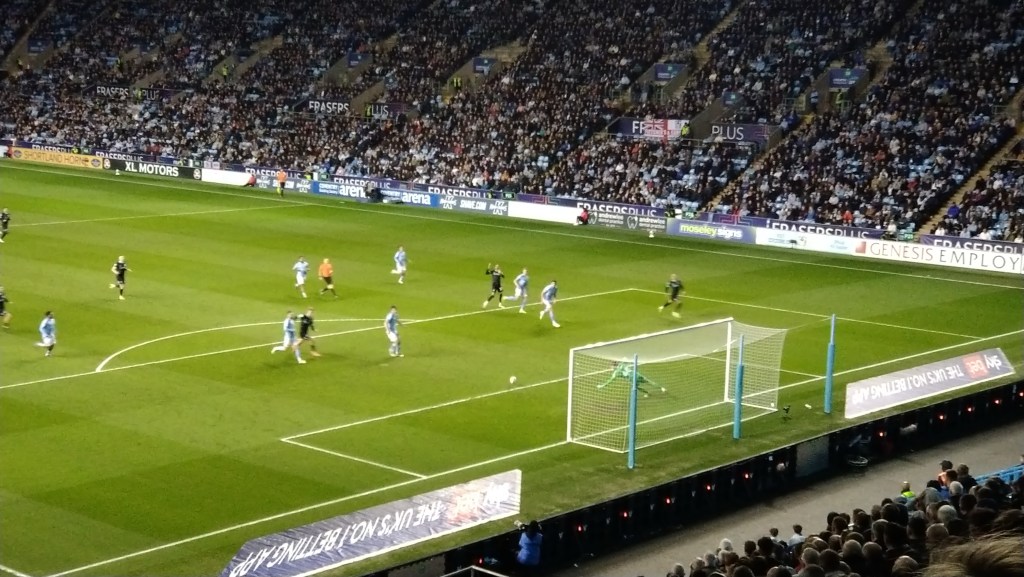
Pompey continued to attack and came agonisingly close to taking the lead on 28 minutes. From Murphy’s in swinging corner, Regan Poole got in a header which bounced off the underside of the bar before eventually being blocked to safety.
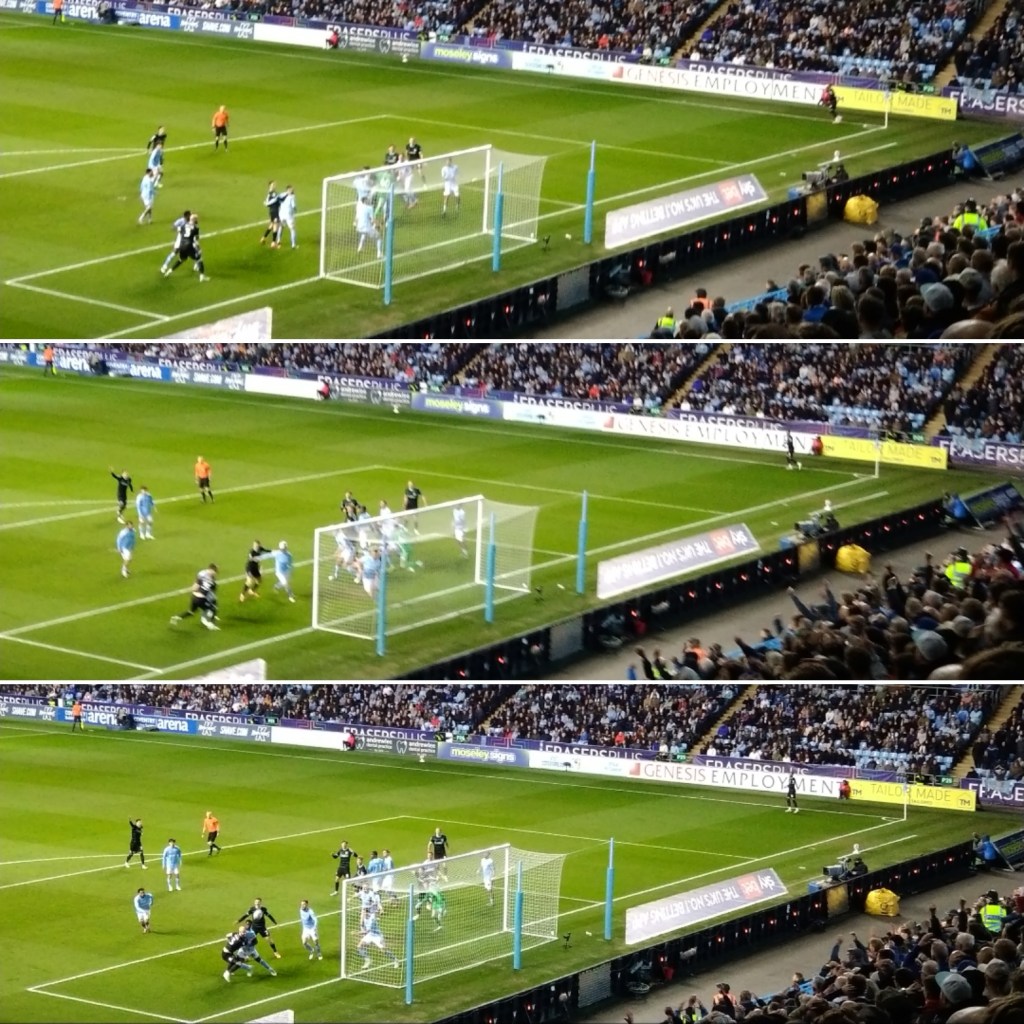
As the half progressed, both sides were fully committed and trying to carve out an opening. Then on 38 minutes, the hosts came mighty close themselves to going ahead. A fine ball out wide by Sakamoto was collected and brought down by Ephron Mason-Clarke, before getting the better of Jordan Williams and some good link up play between Sakamoto and Jay Dasilva saw the ball squared to Jack Rudoni as Ogilvie got in a superb sliding block. But the danger wasn’t over as Milan van Ewijk curled in a delightful ball with the outside of his boot as Rudoni’s header flashed just wide of the post.
Shortly after, Haji Wright burst forward on the wing past Aouchiche into the box before forcing Nicolas Schmid to make a save.
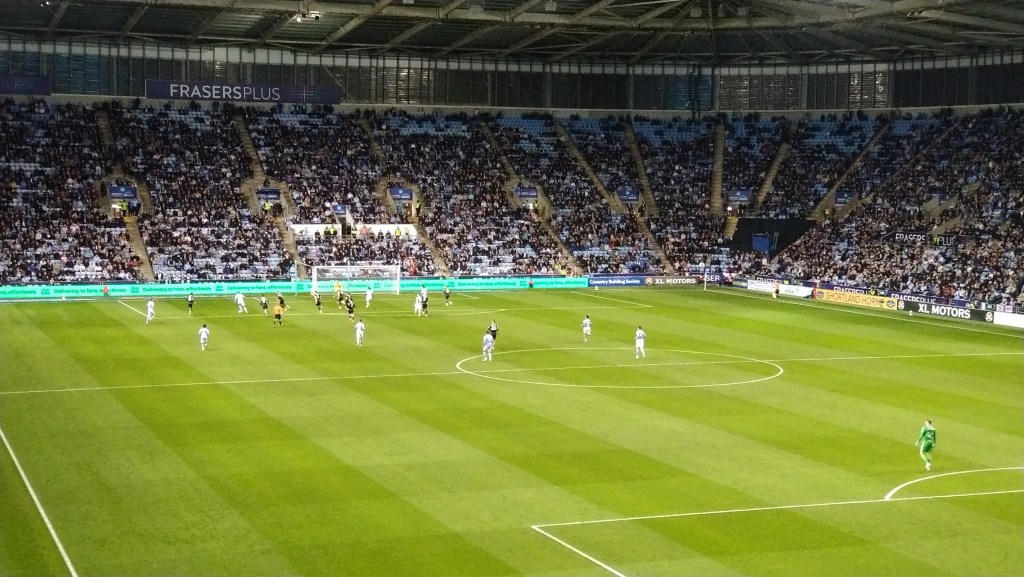
Pompey still searched for that opener in the closing minutes of the first half as Murphy got in a shot from outside the box that he drilled just wide of the post as the teams went into the break all square.
HT: Coventry City 0-0 Pompey
It was a fairly low-key start to the second half for both sides and on 55 minutes, Pompey made a double substitution with Mark O’Mahony replacing Thomas Waddingham in attack with Williams making way for Terry Devlin who plays where he wants as the chant goes.
Then just after the hour Coventry showed more of the attacking threat they possess when Clarke burst into the box before squaring to Wright, but his shot could only deflect over off Ogilvie who once again defended superbly.
Despite plenty of endeavour there were few clear-cut chances, although it was Coventry who were now having more of the attacking play.
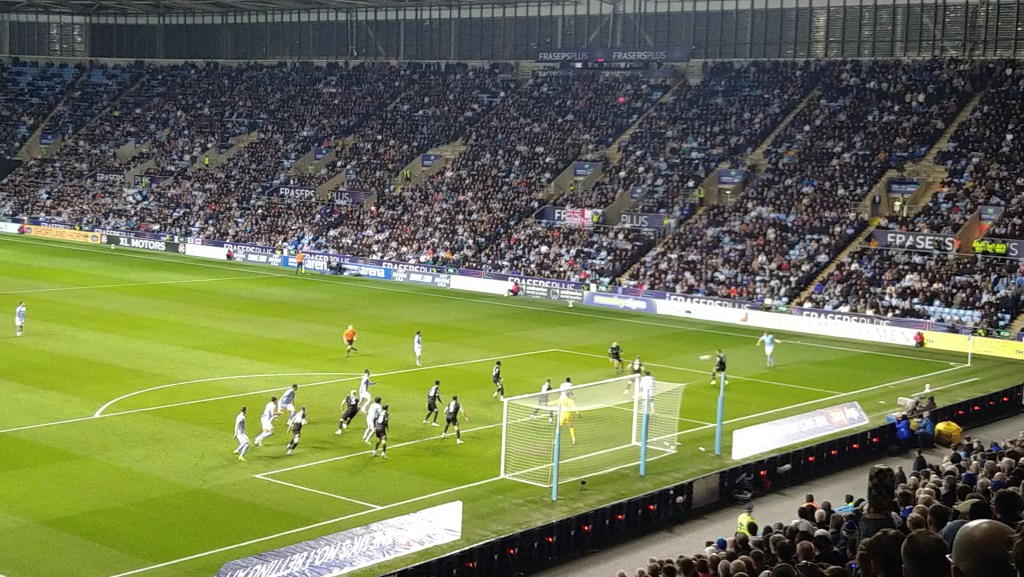
On 73 minutes, Mousinho made his third substitution with Matt Ritchie replacing Aouchiche in the middle. Whilst Frank Lampard then made a tactical change for the Sky Blues as they chased that all important opening goal as midfielder Sakomoto made way for striker Ellis Simms.
From the corner immediately after, the hosts almost broke the deadlock when Rudoni’s corner found Bobby Thomas through a crowded box, but he couldn’t get enough purchase or direction on his header to trouble Schmid.
With 5 minutes of normal time to play, the game saw its final changes with Isaac Hayden replacing Dozzell in midfield for Pompey. Whilst Coventry made a double attacking substitution with Jamie Paterson replacing Mason-Clark and Norman Bassette coming on for Wright.
As the 90 minutes were up, the woodwork came to our rescue this time when Liam Kitching got in a header from Rudoni’s corner that Schmid got his fingers to and flicked back off the post. With 4 minutes of time added, it was one-way traffic from the home side now desperate for that winning goal which they needed to climb back into the play-offs and Pompey desperate to claim a priceless point in CV6. Every half chance that was thwarted and every defensive block Pompey made was cheered by our vocal support as if we had nicked a goal ourselves.
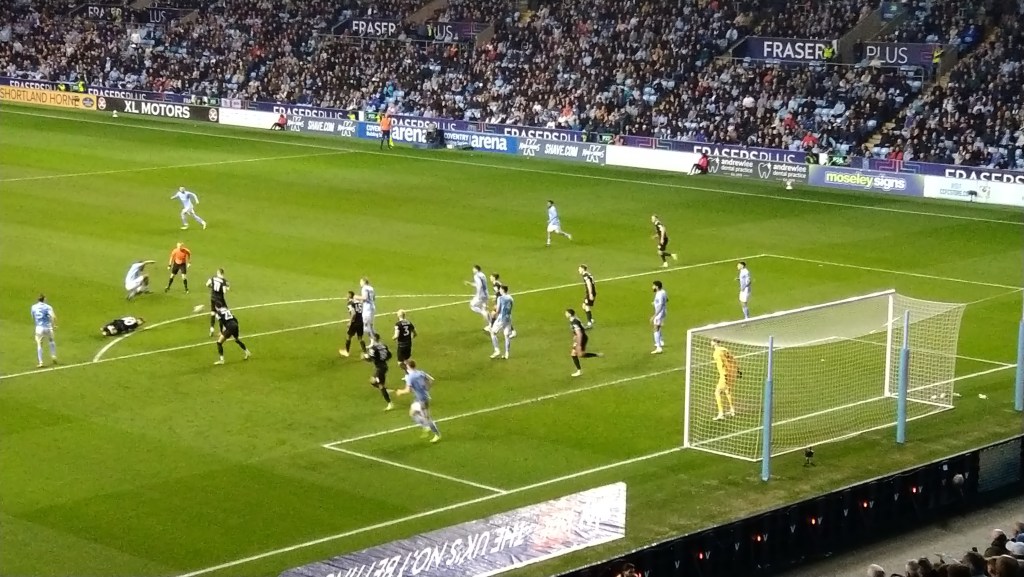
Then completely against the run of play with a minute of stoppage time left we could well have nicked a goal on the counter attack. Murphy surged forward and played in Cohen Bramall as the defender opted to shoot and blazed over. Some Pompey fans have commented that if he had squared to Colby Bishop, he would have been clean through to score. But its only when you pause the replay you can see what a split-second window Bramall had to do that and even then the final defender may well have got there before Bishop.
But no matter what stage in the game, if you don’t take chances they can come back to haunt you and with virtually the last kick of the game we were left shell shocked in spectacular fashion. From the resulting goal kick, Collins lofted the ball high up into our penalty area as it bounced over Ogilvie to Rudoni who teased our defence before cutting back to the unmarked Paterson, who volleyed an absolute screamer into the corner of the net giving Schmid no chance.
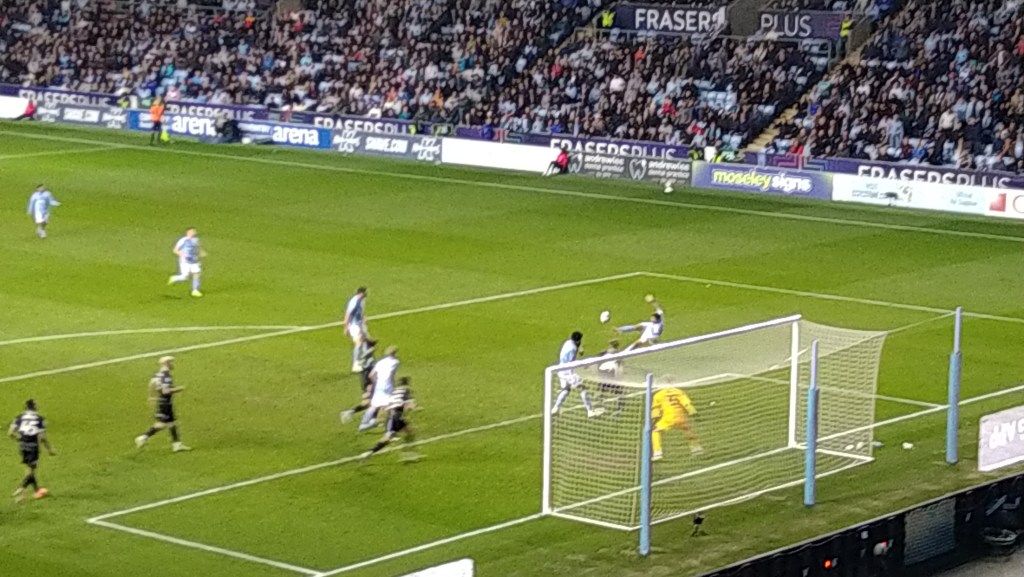
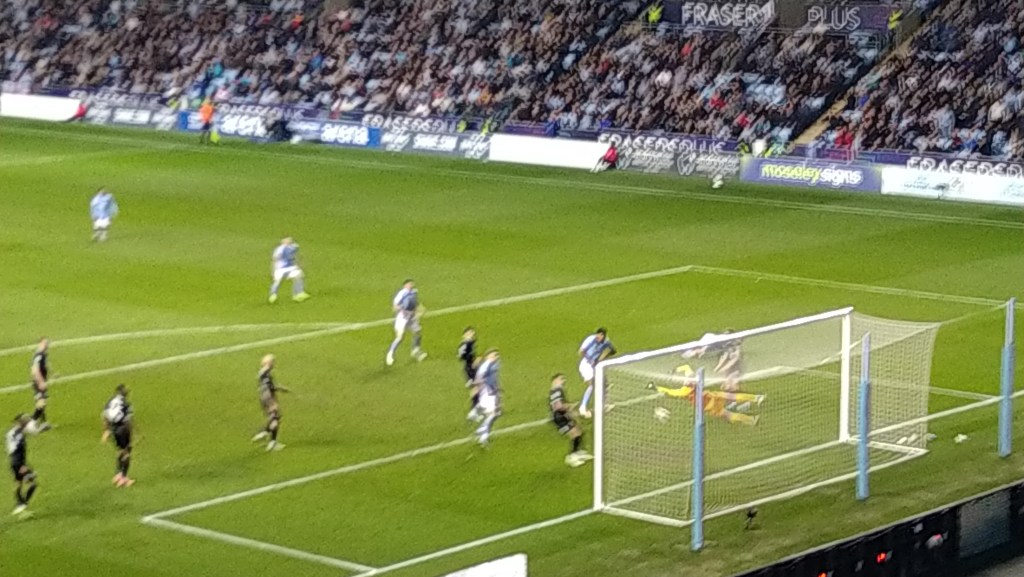
What a way for the Cov lad himself to score his first ever goal for his boyhood club. Cue a crescendo and wild celebrations around the CBS as moments like this can define a season, as many Coventrians I’m sure sensed this as a potential catalyst to reaching the play-offs.
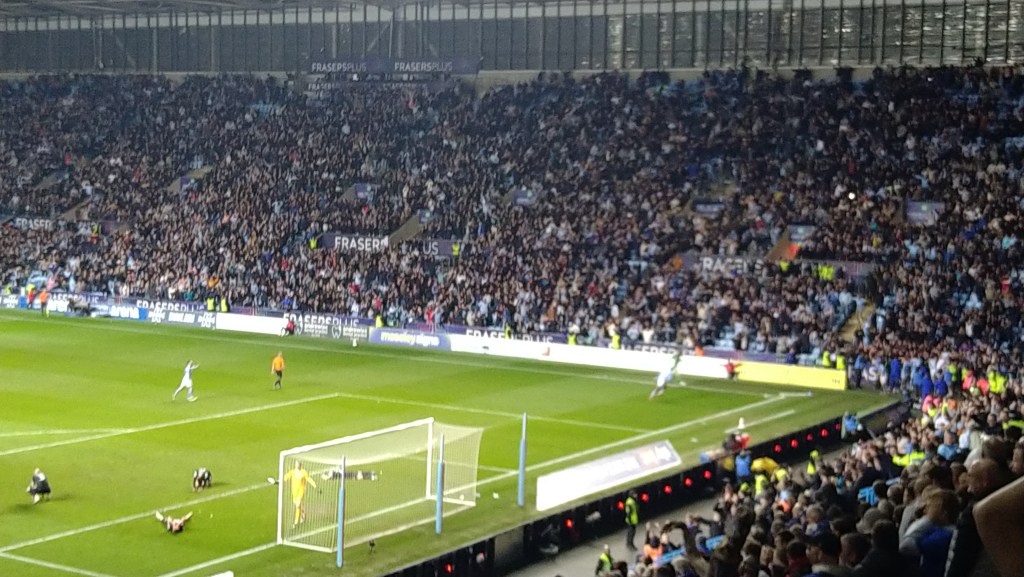
As the Pompey players and fans saluted each other at full time, there was a feeling of numbness but one of so many positives and pride in how we stood up to the challenge for all but all of the 94 minutes.
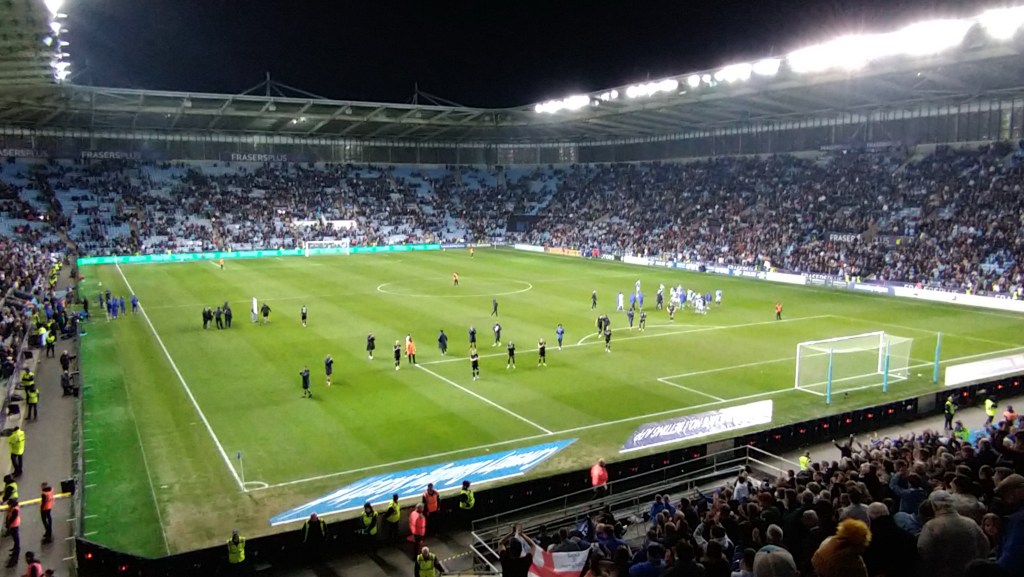
With my wife Ajit, her family and good friends of ours all coming from the city, ordinarily I would have been delighted for Cov who are a club overdue some good fortune. During the past 15 years, they dropped into League Two (that resonates), endured the upheaval of having to play at Northampton and Birmingham, lost on penalties in the Championship Play-Off Final two years ago and (having gone with Ajit to Wembley myself last season), how cruelly denied a place in the FA Cup final they were with what surely would have been the greatest giant killing comeback in living memory.
But typical their joy on Wednesday night should come at our expense as we stay 17th and alarmingly only three points above the relegation zone. This win for the Sky Blues leapfrogs them back above Middlesbrough into the final Play Off place and two points clear of the Teessiders.
FT: Coventry City 1-0 Pompey
Att: 28,411 (2,445 Pompey fans)
Results elsewhere in the Championship on Wednesday night proved favourable for Pompey as QPR won at Oxford and Swansea beat Plymouth to make relegation now seem highly probable for Argyle at the bottom. This leaves a fascinating seven horse race to avoid the other two relegation places in the final five games – it will take a brave person to predict the unfortunate two.
So late disappointment once again on the road for Pompey puts added pressure on ‘Fortress Fratton’ living up to its name this afternoon as we take on 21st place Derby County in this massive ‘six-pointer’ at Fratton Park. Mousinho’s side will be looking to wipe away the memories of our 4-0 debacle in the reverse fixture at Pride Park back in December. Whilst the Rams will be looking for their first win in PO4 since confirming our relegation to League One in April 2012 – hopefully that won’t be a bad omen! PUP PPU.

 PompeyNewsNow
A very interesting and informative blog
A very nice read and some very good historical facts about the city of Coventry and the football club – thank you.
LikeLike